Monday, April 22, 2013

The Competitive Spirit

The school year in Malaysia divides into two semesters a year, but beyond this fairly straightforward division, there's a secondary set of deadlines: the extra-curricular ones. At the beginning of 2013 was Sports Day - teachers responsible for the school's sports teams had up to a month off classes training and preparing the kids. First comes the zone competition - around ten schools competing in sports from badminton and football, to the South-East Asian sport sepak takraw. The winners move on to compete in the District competition, then regional, then state, and then, for a single school from the whole of Sabah, to national level. 

Last week began the second deadline of the year: the Pesta Ko-Kurikulum (Extra-curricular Festival) - a sort of talent show for the kids. And being the local orang putih, I got asked to sit alongside the headteachers of my zone to judge the first phase of the competition.

It focuses on demonstration skills - singing, storytelling, public speaking, and so on. You would recognise most of that list from your own school days. Then we move on to the more diverse stuff. Like gong-beating, for instance. Nation-wide, there's also choral speaking, which is supposedly descended from something British people used to do, back in the dark days of Latin and grammar translation. Nobody I know has ever heard of it, but it's a really big deal in Malaysia - one of the main events of the Pesta.

Choral speaking is done in a large team of around 30 children aged 10 - 12. They literally speak in chorus. They can't move their bodies below the hips, and aren't allowed to use any additional props or materials, wearing only their school uniforms - relying on their voices to bring interest and liveliness to a set text. A single conductor stands at the front, usually wearing white gloves, leading the chorus with gestures and claps. It's impressive to watch when it's done well. 

To do it well means a LOT of training for the kids. Most of my schools had almost no lessons last week, trying to prepare their teams. On Tuesday I got asked to help with the pronunciation of one of my school's teams - I did protest weakly that this might open me up to accusations of bias as a judge, but there was no refusing the school's headmistress, who is a fiery disciplinarian! (Also, as all the judges come from the zone's schools, they all have teams competing in each section, so really, I'm no more biased than the next judge...)


The next morning, they competed, still mispronouncing responsibility despite the two hours of pronunciation work the previous afternoon, and won! Not terribly surprising, as this group of kids is one of the few to seek me out at school to speak in English. Afterwards I got a big hug from the conductor, and a dirty look from a teacher at another school... ;)


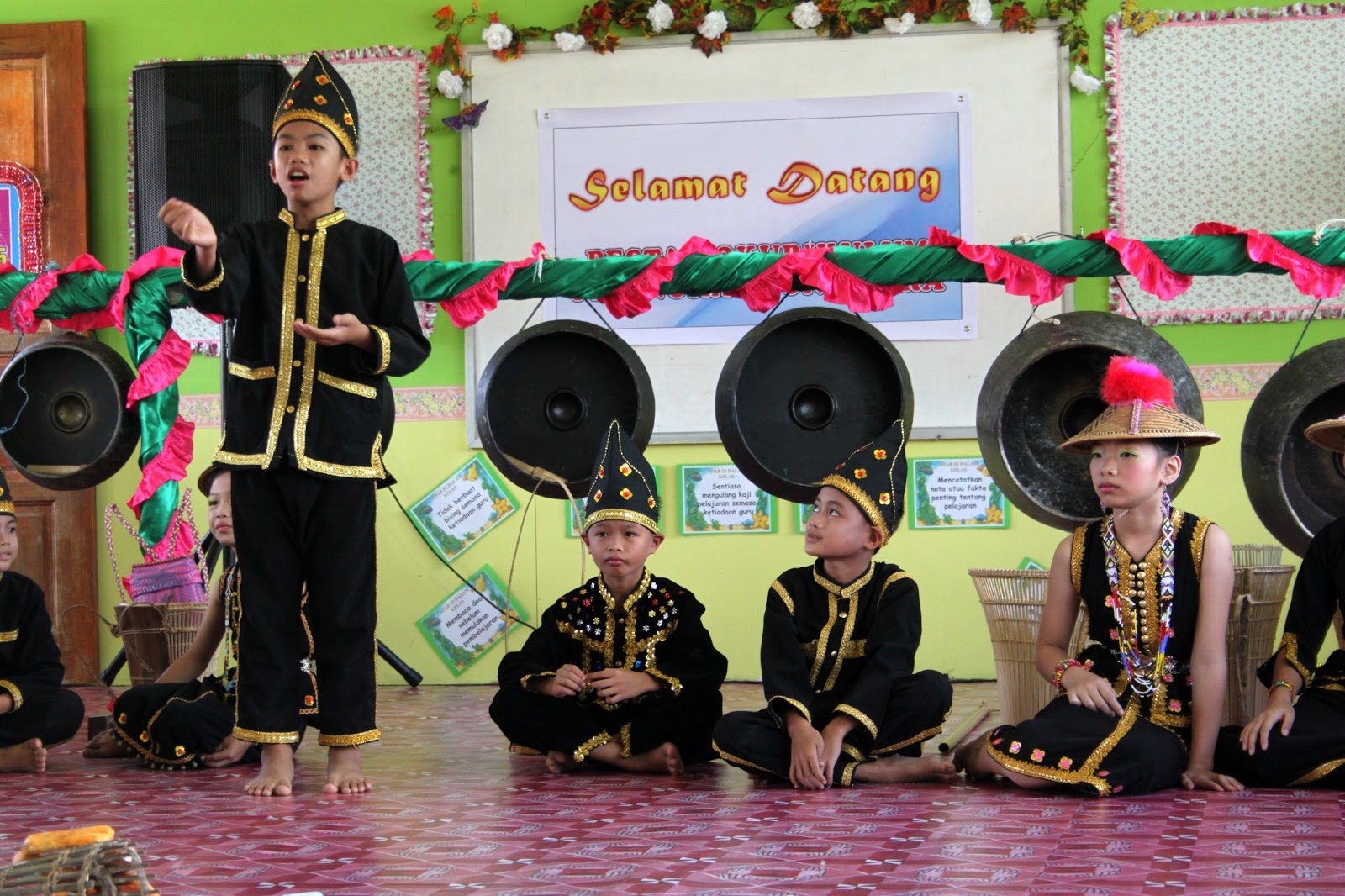
My judging duties discharged for the day, I went to sit with one of my mentees, a preschool teacher, to watch another of the localised competitions - the taboi-aboi. This competition is only done up to district level, as it is performed in a local dialect of the Kadazandusun language, which isn't found outside Sabah.

The taboi-aboi is excellent. Done by a group of 8 to 10 children, it is based on local stories, usually about harvesting fish or rice. The children speak, sing, and act, all the while dressed in traditional costume. One of my schools used a story from a Kadazan tribe (generally Kadazans are lowland tribes, and Dusun are  found in the highlands, while sharing very similar language and customs.)


They were so good that, despite the fact it was in a language of which I know two words ("Thank you", "You're welcome") I could follow the storyline.

The next day, I was back at 8am, ostensibly to judge the Action Song competition, but in reality to sit and wait for nearly two hours while they dealt with "technical problems." I took the opportunity to go and steal some hot Milo from the teachers from one of my schools, who were camped out in one of the classrooms, preparing their children for the contest.

Action Songs is open to Year 3 students. Now, I do know a lot of the Year 3 students in my schools, because they tend to be the ones that my teachers teach, and therefore I observe. But Action Songs just kills me: I cannot recognise a single one of them. This is why:


The make-up on these 9-year-olds might realistically be called "Extreme Make-upping." The classroom was a mass of teachers and parents applying deep shades of eyeshadow to the children.


And don't think the boys get away with it either:


The performances also involve props and costumes and the kids have a lot of fun, grinning their way through any song that could conceivably have appropriate actions to attach to it - Lion Sleeps Tonight is a popular choice every year, and a couple of schools chose Daddy's Taking Us to the Zoo Tomorrow as one third of their permitted medley. Some were a little more adventurous, and one school took for their theme "Happiness," with the little girls singing You Are My Sunshine to the little boys.
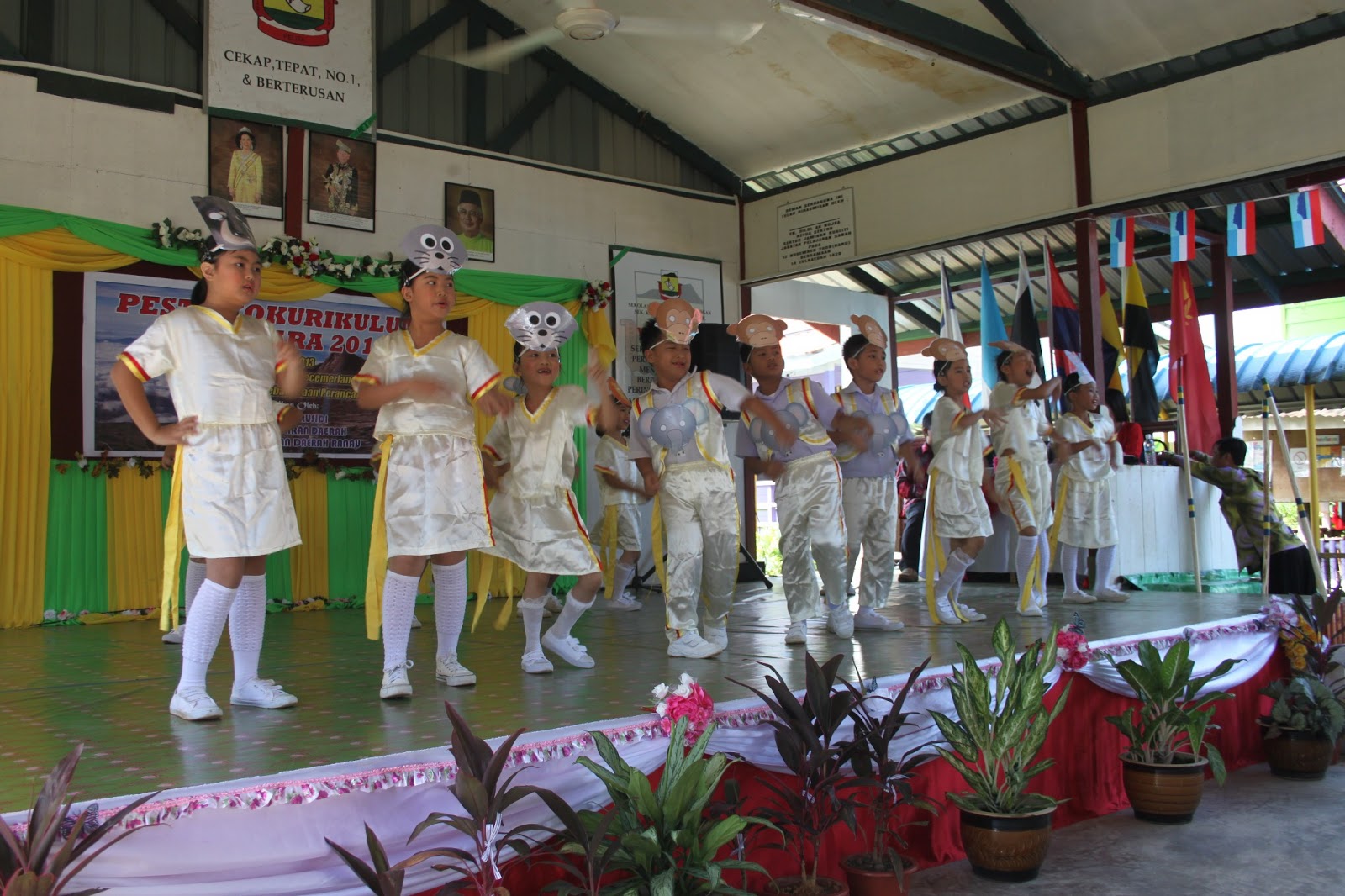


I've been trying very hard to imagine the equivalent ages in the UK performing the Morris Dance with glee on their faces, and am so far failing... :)

Saturday, March 30, 2013

An Appeal

I work in some beautiful schools in rural Sabah. The teachers are committed, the children are bright and starry-eyed, the grounds are invariably a wonderland of ponds and flowers and orchids.

There's just one thing that gets me down: the libraries. The libraries - although cared for by the teachers -are full of cheap books that are way above the heads of most of the students, illustrated with dated depictions of life in the 1970s which don't support the actual text, usually falling apart through intensive use and/or the general mould-inducing climate of Borneo. Some schools have a box of books donated by the New Zealand government a couple of decades ago - these would not now be used in New Zealand, and there's no reason my schools should have to settle for lower quality books than those used in our own countries. Some books are so moralistic that they do not encourage reading for pleasure.


So.

I'm asking you to please consider contributing a book or two to one of my schools. I am here for another 6 months, and all books received will be distributed fairly* amongst the five schools I work with. I will also give support to the teachers in using these books, and make sure that they don't end up being cosseted in a box in the librarian's office, and never given to the children - which has happened in the past, when donors demanded that the books be kept in excellent condition (what beloved children's book is ever in an excellent condition?!)


There are a few ways that you can donate books.
  1. You can send me a gift certificate for FishpondAmazon UK or Better World Books. You can buy gift cards for as little as you like - any amount will help us, even if it's just £1. The certificate codes will be distributed amongst the schools, and teachers will be able to choose high quality books for themselves.
  2. You can buy a specific book from Amazon, Book Depository (free delivery to Malaysia), Better World Books, or Thrift Books (or another site of your choice) and request shipping directly to me. Please let me know if you need an address. We have created a wishlist here, although of course you are not restricted to buying only these books!
  3. You can buy books in charity shops or bookshops, or through Amazon's second-hand offers, or raid your old and no-longer-used bookshelf, and send them to us - I will provide you with an address, and distribute the books to the schools.
  4. If you are interested in supporting local Malaysian writers and illustrators, you can buy books through Silverfish Books - we love anything by Yusof Gajah, Margaret Lim, and Jainal Amambing.
If you would like to buy or donate books directly (rather than buying a gift certificate), please see the list below of authors that would go down well with the ESL learners in my schools. We would love you to put your name inside the front cover, to let schools know who the book was donated by. The children here are fascinated by foreign children - if your children are sending a book, please feel free to include a photo of them reading the book, to give our students a sense of connection to the previous owners. You could also do this if you are a teacher, and your class sends a book.

What do you get back? We guarantee you a warm feeling in your heart! We also promise, if you send us your e-mail address with your donation, to send you some photos of the kids enjoying your books.


Our Desirable Authors (not a complete list!)
  • Eric Carle
  • Bill Martin, Jr.
  • Julia Donaldson
  • Yusof Gajah
  • Janet & Allen Ahlberg
  • Oliver Jeffers
  • Nick Sharrett
  • Margaret Lim
  • Raymond Briggs
  • Jill Murphy
  • Rod Campbell
  • David Wiesner (wordless books)
  • Valerie Thomas
  • Lucy Cousins (Maisy series)
  • Lift the Flap Fairy Tales (Macmillan publishers)
  • Books from Macmillan's Children's Readers series
  • Any books with simple, repetitive language and bright pictures
Please do not send:
  • Books without pictures: very few primary school children are able to read these, in my schools. If you would like to donate these, please let me know and I will provide you with the address of a local high school who would appreciate them.
  • Older books with lots of old-fashioned text (we already have plenty of these!)
  • Books with pigs as main characters - these are very unpopular, even with non-Muslim children.
  • Religious books - for obvious reasons.
  • Ladybird books - these are available in Malaysia quite cheaply.
Contacting me

Please e-mail me if you would like to donate.
Or, you could leave a comment below.

*The Power of Reading Programme

One of my schools has already been accepted to the Power of Reading Programme, and won't be receiving any books from this appeal, unless there is a large response (fingers crossed!) You can find out more about the incredible impact this programme is having on schools in Borneo in the video below - this impact is the reason I want the rest of my schools to benefit from floods of great books :)


Thursday, March 28, 2013

Reading for Pleasure

When I first arrived in Sabah, it was a month before I realised that any of my schools even had a library. This was partially because some of the teachers were embarrassed to show the library to me, and partially because some schools actually didn't have a library - in one, they had a few books in boxes, and a room without a floor. The lack of a floor was pretty serious, as the building was two metres above the ground.

When I moved to the more urban schools the situation was a little better. They all have libraries, even if the room doubles as a faculty meeting room and the children can't access it outside of their scheduled library class. And they all have books - although those books can sometimes be less than entirely appropriate...  Librarians don't know where to find high quality books, and are preyed upon by visiting salesmen, who push substandard, flimsy books riddled with spelling errors and grammatical bruises. Sometimes, books get donated by foreign governments; these are either culturally insensitive, or, again, substandard fare that wouldn't be given to their own students, but are dumped on Malaysian students because "something is better than nothing." I disagree a fair bit with this statement, but that's another tale.

Anyway - as I've mentioned before, when my schools were offered the chance to apply for a book flood, three of them leapt at the opportunity, and in the end, one of them was chosen, and they have done the most amazing things with their Year 1 to 3 classrooms, trying to engage the children with the new books. Remember this classroom?


 Here's what it looks like now:


It's being used constantly, for storytelling lessons in English, but also for remedial classes, Science, Malay language lessons, Maths games, and just chilling after school. I am continually being amazed by how appreciated the teachers' hard work has been in the four weeks since we finished these reading corners at 10pm on the night before the opening day!


Thursday, March 7, 2013

Depictions of Violence

The saga in the east of Sabah continues.

Airstrikes have been used on the less-than-200 invaders in a coastal village who formed the backbone of the main siege situation - which seems a little over the top to me. We are receiving daily missives from the government informing us that the situation is under control, although today a Special Security Area was announced, which rather challenges the notion that everything is fine again. A number of Malaysian commentators have noted that "The situation is under control" is just something that's said, you know, in these kinds of situations - like, "Don't worry, you're going to be just fine", or "The cheque's in the mail." It's a matter of form.

In Ranau district - which is about as far as you can get from the Special Security Area without leaving Sabah - tensions have been running high recently. The Royal Army of Sulu is pretty much the only topic of discussion in the canteen.

On Tuesday, near one of my schools, villagers summoned the police, worried about the sudden appearance of a number of Sulu flags, with a sizeable group of Filipino workers in the timber camp nearby being accused of sympathy for the terrorists. The police had to reassure the villagers that the flags weren't Sulu in origin, and  had in fact been put up by an overenthusiastic member of a new political party, as part of the election campaign.

Another day, one of the same Filipino workers asked for a couple of hours of credit at a local vegetable stall, a common enough request in these parts. The stall-owner refused and called the police, accusing the man of trying to steal from him. The policeman, apparently with an eternal well of patience, calmly pointed out that the stallowner still had the vegetables in his possession.

I do feel sorry for Filipinos in Sabah at the moment; the lack of sympathy is astounding. Malaysians are in deep shock at the deaths of eight policemen during the fighting, and are genuinely afraid of what might happen if the 800,000 Filipinos living in Sabah decide to join the cause.

This is not helped by the flood of militant photos and videos on Facebook and the internet. The pictures are violent and scary, showing masked soldiers and guns and prayers being said before battle. 


They get more and more graphic: I have (unwillingly) seen pictures this week of decapitated heads being carried by weeping women; dead bodies with their Philippine Army boots highlighted, and corpses in begging positions, their blackened arms raised above their heads. They are more explicit in their depiction of death than I have seen in Western media, but my colleagues do not seem as fazed as I am. Photos of Malaysian deaths carry doas or prayers written on them; Philippine death photos raise questions with the government, for instance, "Why does this man have a Malaysian ID card? Did you invite him here Mr. Prime Minister?"

But the very worst so far came in the staff room at one of my schools, where, before I realised what I was being invited to see, I was seeing the first two dead policemen being beaten and sliced open and kicked by the Philippine invaders, the whole event being filmed on one of their phones for posterity.

With rallying cries like these, is it any wonder that this national grief and terror is continuing unabated?

Sunday, March 3, 2013

Sulu sea piracy

Pirates have landed. I'm not kidding: an army of desperate pirates from the Philippines arrived on the east coast of Sabah a few weeks ago, and have proceeded to engage in a number of standoffs with the police and army.

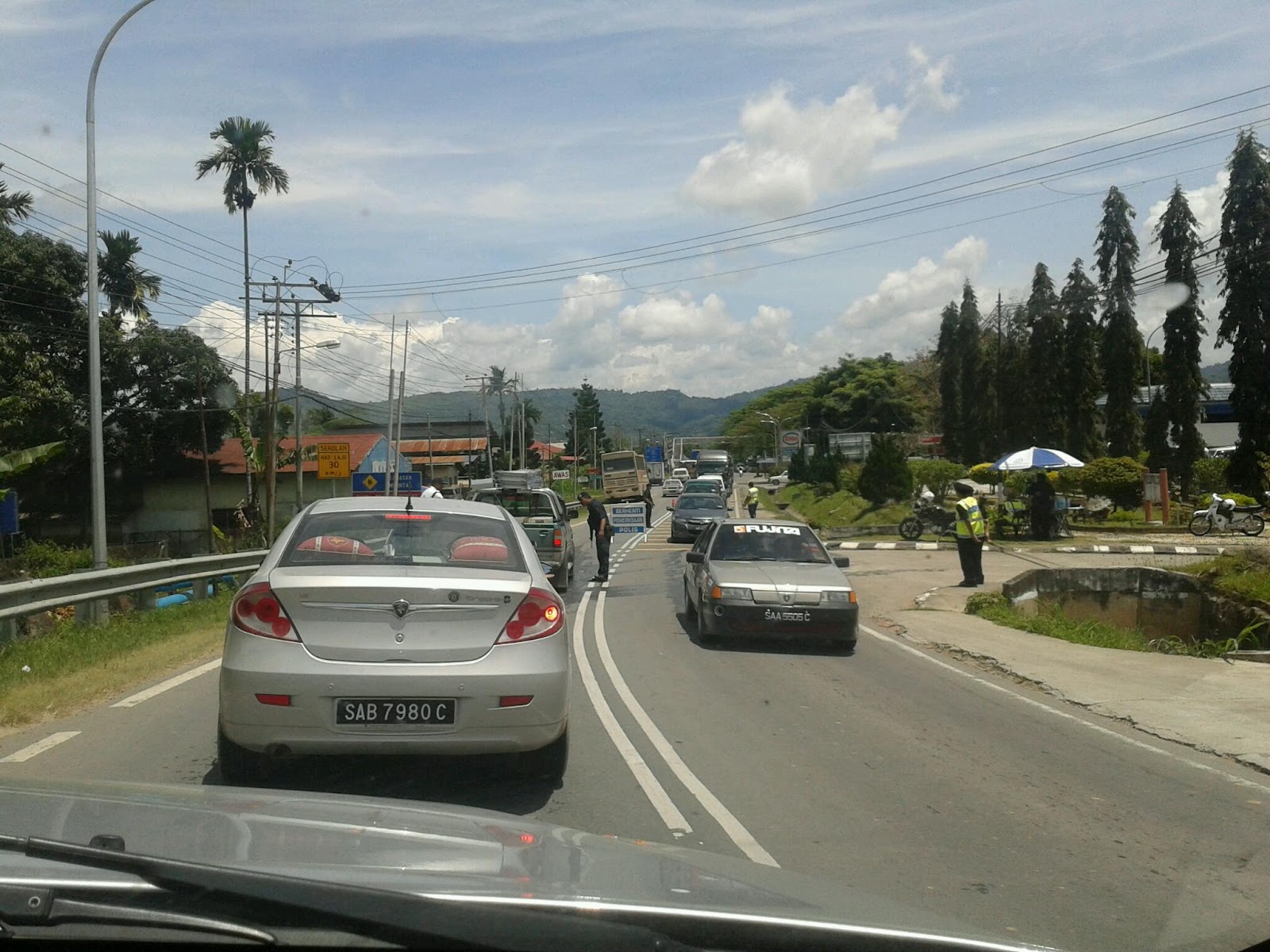
At the beginning, all we in the interior knew of it was colleagues on the east coast having to drive through several police roadblocks a day. But it's descending into gunfights and deaths, and while the town of Lahad Datu has become a ghost town and our colleagues are staying home, we further inland are also now dealing with roadblock after roadblock. Each car must be stopped, and each driver and passenger scrutinised. Suspicious cars are pulled over and papers examined. And god help you if you happen to be Filipino.


Now, the story itself is rather romantic, in the historical sense rather than the love sense. The invaders call themselves the "Army of Sulu" and they are led by the brother of the Sultan of Sulu. A couple of centuries ago, the whole of northern Sabah was given to the Sultan of Sulu by the Sultan of Brunei - because that's what monarchs do, they give each other huge swathes of land and dominion over the people who live there (the Sultan of Brunei also gave most of Sarawak away - to the white rajah, James Brooke. But that's another story.)

Later on, the Sultan of Sulu came to an agreement with the British North Borneo Company, leasing the land in perpetuity on payment of a yearly rent.

So far so good.

Then came the Second World War. Poor little Sabah got bombed twice, once by each side, and then afterwards, the Company bankrupt, it got handed over to the British government. The British government later granted independence to the Straits colonies, which became the Malayan Union, and then, in the 1960s, Sabah, along with Singapore and Sarawak, decided to join Malaya, and form the Federation of Malaysia.

The problem is that the Sultan of Sulu leased the land to the British North Borneo Company, not to the government of Malaysia, and although Malaysia still pays the rent each year, the Army of Sulu is keen to remind everyone that Sabah still belongs to the Sultanate of Sulu - and therefore, in modern terms, to the Philippines.

You see the problem?

An additional issue of course is that it's election year. On the one hand, the government doesn't want to be embarrassed, while on the other hand, it's been mooted that the invasion has been especially engineered in order to allow the government to show Sabahans that they need them - Sabah is currently not a safe win for the ruling party, and we've been seeing a lot of politicians lately, handing out cash to poor families and students and generally showing Sabahans that they're a good bunch, really, why vote us out now?

And while the endless roadblocks are an annoyance, should the Malaysian government not come to some kind of peaceful resolution that will avoid incensing the nearly one million Filipinos in Sabah, we may be looking at more serious disruptions to deal with in the weeks to come.

Thursday, February 28, 2013

Difference

When I lived in South Korea, I was often met at the doors of shops with the welcoming statement, "No, no, no big sizes here, go other shop." The crazily tiny and beautiful Korean girls meant that I was seen as huge, although in most Western countries a size 10 might be seen as being just fine, thank you very much.

But all is not lost for my self-esteem in Asia:

The other day, here in Sabah, I walked into a little shop. As I passed the counter at the doorway, there was a sigh, and the shop assistant murmured, "So beautiful, lah." And yes, she was looking at me ;) I checked...

Now this is the kind of place I like to live!

There are two downsides to being the kind of person that draws sighs of admiration from lovely Malaysian girls.

The first is that the commentary doesn't always come from the girls, it's often too blunt, and it's not always wholly complimentary. A headmaster's comment on seeing me for the first time in three weeks recently: "Emily, you are looking so slim and beautiful. Your body looks very good like that. Have you stopped eating? Because last time I saw you, you were getting quite fat." Yes. Cultural norms can be a bit of a shock.

The second, of course, is that often, and I am reluctant to admit this, the admiration isn't of my actual beauty, my perfect skin, my soft, wavy hair, my slender body... none of which are attributes I can honestly boast of. The admiration is of my white skin - the paler the better: the compliments tend to dry out after I've spent a couple of days on the beach.

Many Asians are so locked into a particular ideal of beauty that I have to really search for non-whitening cosmetics - and we're not just talking about face cream here, but even deodorant, which advertises its whitening properties in nice big letters. Because, you know, pale armpits are one of the first thing men want to see.

It's such a shame, when on the other side, us orang putih are trying our very best to darken our skins...

It's a crazy world.

Monday, February 11, 2013

Superlatives in Dubai

Arriving in Dubai in the dark is like I have always imagined it feels to arrive in Las Vegas. It's pitch dark, nothing out there - no snaking highways lit by streetlights in the early hours of the morning, no small towns - then suddenly there is light, a lot of it, and in the middle, the strip of the runway.

By the time I've landed and have negotiated immigration and the tour agency that forgot I was coming, it's light and the city is laid out below me as I travel from the airport to the city centre by sky rail. It feels like a building site, or rather, it is a building site, and the sky rail twists and turns between and under glass and chrome, and past the occasional sand-coloured suburb. There's not far to go though, which feels strange; my knowledge of Dubai as a booming Middle Eastern city, which has come from glossy magazines and documentaries on 7-star hotels, hasn't prepared me for what is actually a very small collection of homes and businesses.

I had planned to leave the city on a tour of oases and seaside villages, but as the tour agency has messed up, I end up spending the whole day in amongst the the excesses and luxuries of the capitalist capital of the world. The excesses can be extreme, and pretty odd when you consider them - why, in a place with rather a lot of available space, would you build tall buildings? Or, in a region with a bit of a lack of water, develop a golf course? People are strange in their pursuit of self-aggrandisement and pleasure.

So I spend my time exploring some of the ways in which Dubai is superlative.

The tallest building in the world.


It's pretty big. It's more than 800 metres high, and the lift, when we stop at the top, actually has the number "124" after the word "Floor". It's kinda cool.

Also, the biggest aquarium in the world...


...with the largest collection of sand tiger sharks in the world...


...and the biggest single panel of glass in the world...


...situated in a shopping mall that contains an entire taxi fleet.


The world's most luxurious shopping malls - even the smaller ones...


...the world's cleanest subway stations...


And, I expect, the world's tallest Model-Of-Burj-Khalifa-Made-Out-Of-Ferrero-Rocher.


It's a pretty remarkable place, really, a strip of hyper-development in the middle of the sands of the desert. Being well-acquainted with the airport, it's interesting to finally get outside and see the city. At least, the malls, although I do sit on the sky rail a lot as well. And the malls are truly something to see. Whatever shop you've got down your street, the Dubai Mall's got a bigger and better one. Really. Nando's. Marks & Spencers. Cold Storage. That Irish pub you've all got nearby. There's even a Bloomingdale's - although at first I don't realise I've seen Rachel's iconic place of work because here, it's in Arabic.


Towards sunset, I get on the train to go to the Creek, which sounds nice and simple and deserty, but when I get to the stop before the one I want, the train stops and everyone is asked to leave the carriages. I hesitantly approach the men at the exits, who laugh and tell me it's been closed for some time, the Creek stop. "Why?" I ask. "Because there's nothing there!" they laugh. I point to the entry in my mini guidebook that has it as a pleasant place to sit by the river and watch the sun go down. "Oh yes!", they laugh, "No! Closed down, no longer, finished, go somewhere else." So I go somewhere else.


I stumble on what appears to be The Creek, anyway; there's an open-air museum on the side, with clay houses and camels and calligraphy exhibitions, and it's rather nice after all the glass and steel to see a bit of raw ground. It's not quite real, though - sort of charmingly clinical. It's a bit like Sun City outside Johannesburg - 100% African, and yet not African at all...


Eventually it's time to get back to the airport for my flight onward to Malaysia. It's been interesting, but I'm looking forward to being able to stand outside for ten minutes without requiring air conditioning as a matter of medical urgency. I never imagined a year ago that I would consider Borneo to have a pleasant temperature, but Dubai's been extreme in more ways than one.

Timing

Timing is everything, huh?

I got invited by a friend who lives in my village to attend the wedding of her neighbour. As you may have picked up from other blogs, weddings here are an open affair, and any passing stranger is welcome to drop by for a bite to eat. I knew that the wedding was happening - it had been happening all day, with cars roaring past my house, filled with gong-players escorting the wedding party to the Catholic church in town, and back again, then music, then entertainment for the family while photos were taken at the hot springs, then more gong-playing. 

So I walked up the road to meet my friend, and she brought me to the village hall, where some of my students were performing the bamboo dance for the bride and groom. We peeked in through the window for a while, and then my friend suggested we go and salaam the happy couple. Just then, the electricity went out! Now, this has been happening a lot lately, on, off, on, off - I just keep a candle to hand and make sure my Kindle is fully charged for those very dark hours - and my, is it dark in a village of 100 people when the power goes out!

Anyway, so the power was out. Amazingly the bamboo dancers continued - bamboo dancing is not something I would be willingly doing at the best of times, and here were these young girls committing their slender ankles to bamboo poles being slammed together with force by their brothers, in the dark! Brave kids.

Anyway. So the the power was out. We went ahead anyway, squeezing past the dancers and through the audience, and up to the stage, where the newly married couple was seated. It was very dark, but without appearing too schoolmarmish and crazy (I think...) I managed to squint over at them and offer my congratulations, as my friend explained who I was. They appeared pleased to see me, as all the brides and grooms whose weddings I've crashed have appeared to be. They greeted me politely, and asked me to accept a gift from their bridesmaid, who passed me a golden pen prettily boxed and beribboned - another tradition that always leaves me balanced precariously between my roots (i.e. Give The Bride A Present) and trying to be culturally sensitive (i.e. Accept A Gift From The Bride.)

So there I was, smiling and half bowing and heading off the stage. Which is when the lights came on.

Now, I like to think it was a collective gasp at my awesomeness, but I have to say, it was probably the shock for a hundred people of suddenly seeing an orang putih where none had been before. Like magic! 

I'm just grateful I didn't fall over.


Never mind, at least I got a delicious meal out of it. Yes, ladies and gentlemen, in Sabah they feed their gatecrashers. 

Most of my little students were in attendance as well, dressed in all their finery and squealing "Cikgu Emily! Cikgu Emily!" which is a HUGE improvement on "Orang putih! Aaargh!", and anyway, I quite like being Teacher Emily... 


Thursday, November 15, 2012

End of Year

 So we've finally come to the end of the school year in Malaysia. The last few weeks have been a constant struggle to find and speak to teachers, who have been busy with a pile of administrative tasks. Although the aim is not to take teachers out of class, in reality there is very little teaching time in the last month, as there is no real administrative staff in schools. Teachers have to write, record, and submit reports on each child, take in and report on textbooks, complete data on assessments and progress online, make reports to the local, district, state and national offices, and... well... take part in a LOT of ceremonial days. Yes, ceremonies are a large part of the last month; they're a large part of the year, really, but the last month is crazy.

Ceremonies include preschool graduations in which the children wear little hats and red capes, Parent-Teacher Association fishing competitions, singing and drama competitions, Year 6 farewells, teacher appreciation days, prizegivings, and parent report readings.

The other day, I was invited along to a farewell party for Year 6 at one of my schools. Thinking it would be a bit of makan with the kids and their teachers, I wore a skirt and short-sleeved blouse. To their credit, the headmaster and curriculum head didn't bat an eyelid as they told me that since the exam results have been delayed, the party was postponed until late November, and instead, the day would be devoted to entertaining none other than the State Minister for Education, and his wife. I batted several eyelids as I cast an eye over my totally inappropriate clothing. I did manage to get out of sitting on the VIP couches at the front of the hall with the Minister and his entourage, as we listened to a wee little thing belt out that song about living your dreams and aiming higher. You know the one.


But later on I was called up to the stage for photographs, which rather amusingly ended up being me in short sleeves with around 20 men. Well, not that amusingly...

Then at the end, the headmaster, who is a lovely man, called on me to come back to the stage to receive a gift in thanks for the year, and it was only when I returned to my seat next to my teacher that I realised that this was my new baju kurung.

Baju kurung is the uniform of Malaysian women. All teachers have to wear it in school, although I have seen a few daring women in skirts and blouses lately. It consists of a knee-length, long-sleeved blouse worn over a "sarong" skirt. It's grown on me. When I first arrived I swore that nobody, but nobody, was getting me into what is basically a bright purple (/orange/yellow/other luminous unmatched patterned material) sack, covering as much as it can without putting a paper bag on one's head.

Now, I looked at my present, and said, "What a pretty combination of blue stripes and purple swirls." It has a neckline of large plastic beads. I did tell my teacher that they weren't getting me into the traditional high heels as well, but I'm not so sure anymore that I will be finishing my contract without owning at least one set...

So off I went into the office to get changed, and when I came out, the Minister and his wife congratulated me with big smiles on how pretty I had suddenly become. The teachers all exclaimed and smiled and patted me on the back, and I smiled back and realised that this moment should have come several months ago. Their pleasure shamed me!

After makan, I had to pop into another school where the teachers were having a meeting, and I actually got a round of applause when I walked in.

Unfortunately, although I was asked to pose for photos with every single person at both schools, I didn't take one myself, so you will have to wait until the new year for a photograph of me in my lovely new uniform. 

For now, school is over, my meetings with my Project colleagues are done, the cats are settled and I have found someone to feed and cuddle them while I'm gone. Tomorrow, I fly home to Zimbabwe, and sadza, and Castle beers, and Amarula in morning coffee, and my family and friends, and I cannot wait!

Wednesday, November 7, 2012

New Home

Isn't it always the way? After weeks and weeks of waiting for the teacher's house to be finished for me, and problems with the electricity connection (they didn't want to connect a foreigner), and arguing with the workmen, another school suddenly realised that they too had a house to offer me, and I could move in almost straight away. Although losing all the money I'd spent on renovating the first house was difficult, I decided to move to the second house instead, the benefits including being a short walking distance from the hot springs, and having three bedrooms instead of two. The hot springs was the more exciting benefit, I'll admit.

So. It's a kampung house, a village house. Kampung houses are stilted and wooden, with slatted windows, leaky pipes, bizarre bathroom arrangements, and sinks hanging out the back window. Really. They are usually quite beautiful (if it's not you living in it...) but mine is not.


That's okay. Inside, it's lovely. When I got it, it was pretty dingy, with yellow walls and lots of graffiti. Malaysian graffiti artists are as imaginative as western ones - my favourites include "I love you" and "Hello". The floors were raw wood, and the doors, which were once made of cheap plywood, were now made of splintered cheap plywood. The former owners had nailed wire to the walls of one room as a laundry, and the pretty netted shutters had lost most of their nets, letting in bugs and moquitoes to breed in the nooks and crannies.

The doors are still splintered wood. I'm not that fussy. I did get them to nail some new plywood onto the worst ones, but brand new doors can wait.


What couldn't wait were the floors and walls. Now, Malaysian men are not particularly macho, really, if we're being honest. Which is why it was so humiliating when the workman - who was originally only hired to tile the bathroom - gently removed the paintbrush from my hand and proceeded to do the painting himself. Put in my place, I agreed to pay him extra to complete all the painting. I think he took the same time as I took to paint one panel, to paint four and a half rooms.

BUT I did varnish the floors, so I feel a little more dignified now.

I'm still living as a bit of a camper, but just look at those beautiful floors:


I have kept a lot of the furniture, some of which is better than others, like my kitchen cupboards, which are fronted by, yes, mosquito net, and which are now playing home to my Semporna fish.


Round the back I have a bit of a garden, which hasn't dried out once since I moved in, but which offered up the gift of a sprouting palm nut as compensation.


The cat is less than impressed; the fact that palms are sprouting in my backyard does little to distract him from the fact that I now require him to use said backyard (yes, the damp one) for his littering purposes.

 
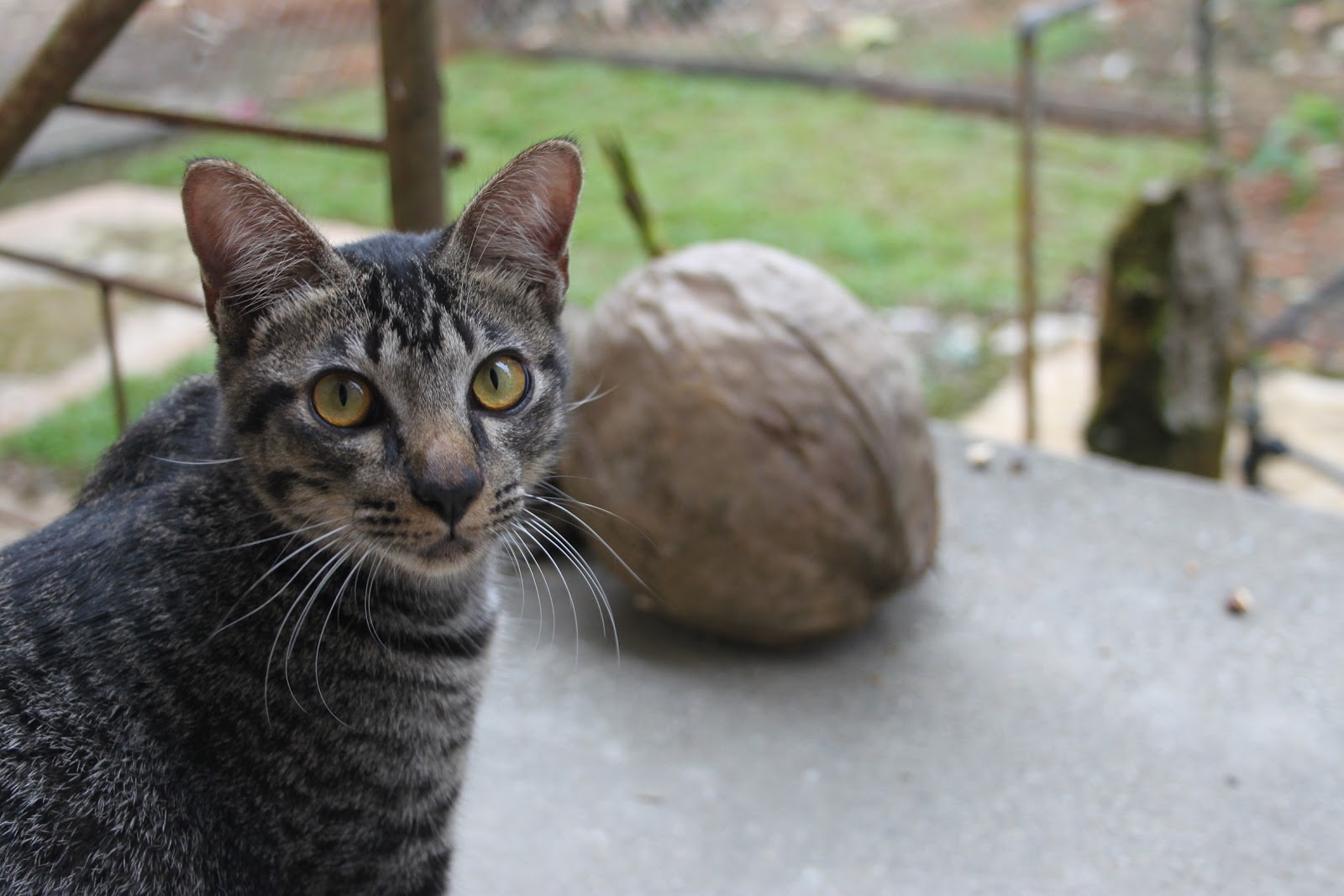
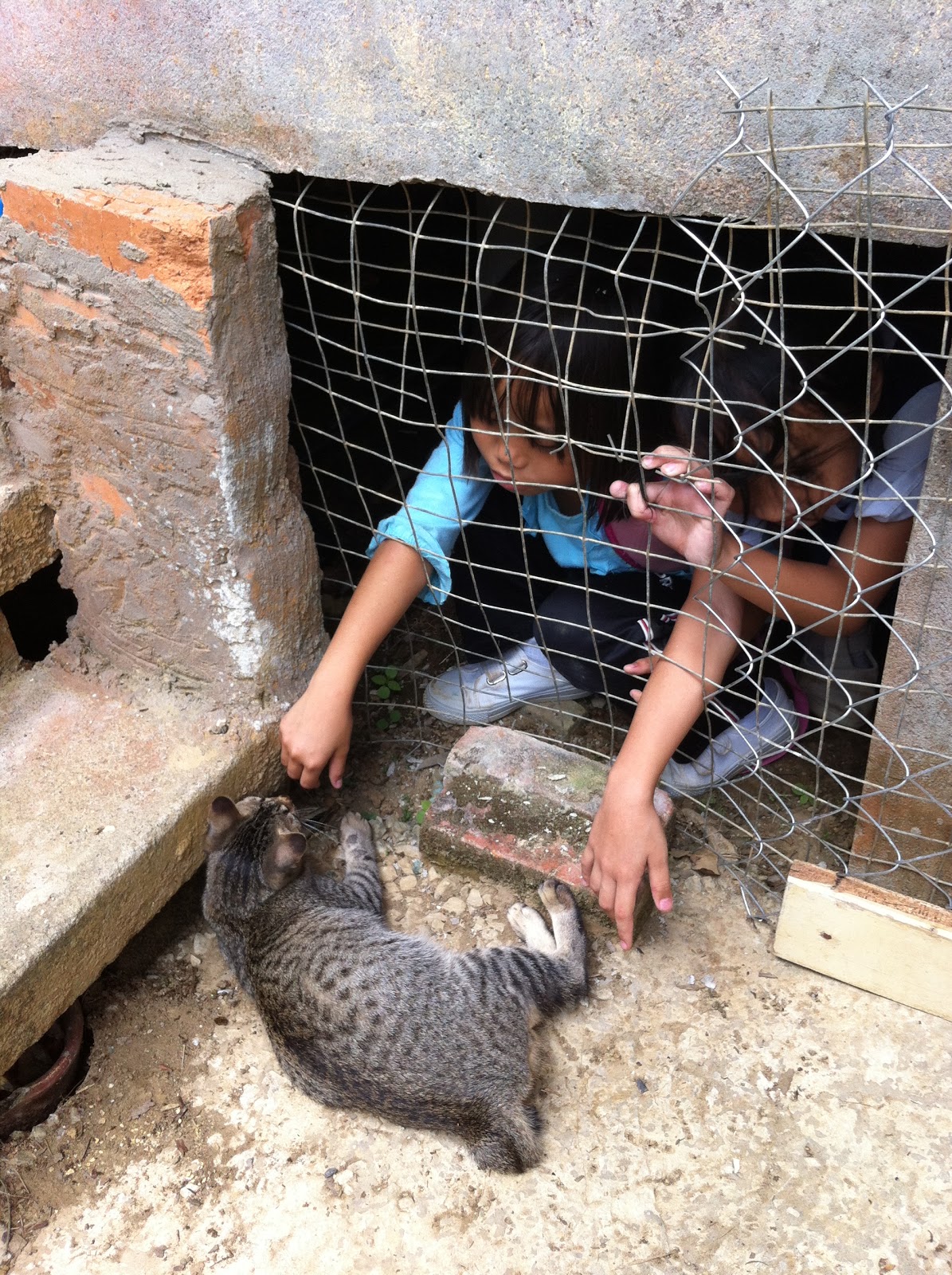
The local kids have already discovered the two cats, calling to them through the fence and giving them the adoration they so rightly deserve. I'd invite the kids in to play, but I forgot to ask the workman to build a gate into the fence...


It's a quiet little village... actually, make that a little village - it's not quiet at all, with the roosters and dogs and people and babies and scooters... but there's not really much going on. The highlight of most of the boys' days is the football match that gets played in front of my house on the school field every evening at 5. The team can be told apart easily - Team A wears shirts, Team B doesn't. It's a change from the inside-out-division.


I have a lovely view over the hills of Sabah towards the second-highest mountain in the state. The highest one is directly behind me, looming over Poring Hot Springs. It's a pretty awesome little spot, really :) I do hope you'll come to visit!