Showing posts with label Bali. Show all posts

Monday, October 12, 2009

Home

The next morning, after breakfast on the deck, we walked down to the Turtle Sanctuary where Bolong was waiting to take us to Gili T for our boat to Bali. It was a short ride - just under 1km - but I was glad we'd all pulled waterproof coverings over our bags, since the sea seemed determined to hug us goodbye - I climbed off at Gili T's harbour completely soaked down my back - it had felt like Neptune had thrown a bucket of water at me, and then laughed hysterically as he went for more... We piled our bags up next to some benches where other travellers were waiting for their boats.

Gili T was far more developed than Gili Meno. We sat in front of what could pass for a village centre anywhere in Bali. Shops lined the waterfront and a square had been built to accommodate the chairs and tables from restaurants. The streets were paved, and where in Meno there'd been two little carts pulled by tiny horses, here there was a whole taxi rank for the carts! (No motorised vehicles are allowed on any of the islands.) We quickly did a bit of shopping for last minute souvenirs in a tiny shop stuffed to the brim with cloths, bags and cool clothes.

The boat, when it arrived, was a large speedboat which didn't look like it could accommodate 60 people. The crew stood on the back and grabbed our bags to put into the hold, then we climbed aboard. Our little group sat toward the back, under the tarpaulin, not wanting to burn again so late in our journey. A bunch of Swedes filled up the sunny spots behind us. Once the boat was full and tickets had all been checked, the engine started up and we set off.

Wow!

It was a very rough sea, and poor Leigh had her head between her knees for most of the journey - I joined her quite quickly too. Waves came thundering over the back of the boat and very soon the Swedes were drenched. Not that we escaped. We'd sat at the join between the permanent roof and the tarpaulin, so water from the roof was directed straight down the fronts of Liam and Cait, who rapidly were as wet as the Swedes. We literally washed off the deck when the boat arrive at Padangbai's pier.

From Padangbai we travelled by minicab with two Scandinavians who were catching the same plane as us. We were taking off in less than 2.5 hours, and with a 1.5 hour drive ahead of us, we were cutting it very fine. Or so we thought. When we arrived at the airport, we joined a long queue of passengers still waiting to check in, and several groups joined after us, so although we had to walk straight from security onto the plane and there was no shopping to be done, at least we didn't suffer the ignominy of having our names called over the loudspeaker!

And then we were lifting off from the Balinese runway and saying goodbye to the beaches, and all too soon Bangkok arrived, and then it was more goodbyes to Liam and Robyn as we left them to their long layover and boarded our flight for Korea.

Arriving back on Monday morning to cold, half-empty English Village was one of the hardest things I've had to do in Korea! So hard, in fact, that within a few days, I'd already planned and booked flights for a holiday in Australia at Christmas! Having that just a short way away makes life seem much rosier, especially as each day brings a new low on the temperature gauge.

Winter is coming...


Saturday, October 10, 2009

Island

It was straight onto the beach and into the sea for us then, a lovely blue-green sea with a slight swell, warm and clear. Heavenly!


We colonised a beach gazebo at the optimum distance for the beers to reach us cold from the restaurant's fridge, and there we stayed until after dark, when, our bellies filled with nasi goreng, we returned to our rooms. We'd requested an extra mattress in our room - there being three girls sharing a double bed - but the owner didn't seem willing, so eventually we just asked for an extra room. Occupancy was decided by the traditional Korean method: Rock Paper Scissors, and Leigh won the extra room to herself. The salt-water showers didn't leave us feeling like the cleanest bodies in the world, but we went to bed tired and happy anyway. At about 10pm, Cait and I were woken up by Leigh whispering at our window: she'd just found a scorpion in her bed! We all agreed it was best to just kill it, and for the next ten minutes listened to Leigh's shoe as it thumped the wall in pursuit. Things eventually went quiet, but in the morning, considering the location off the beach and the slightly unclean feel of the place, as well as the deadly insects in the beds, we all decided it was best to leave. We hoisted our packs onto our backs and went off down the beach in search of something cleaner and prettier, and found it in Rawa Indah, a collection of sweet cottages, fronted with airy verandahs and strung with shells and coral. The owner was Austrian, so no concerns about cleanliness!


We'd made plans to snorkel that morning so we headed back down the beach to Gili Meno's Turtle Sanctuary.


Run by Bolong, a wiry, 30-something islander, it's just a collection of rubber pools and old baths shaded by thatch in which turtles of varying ages doze on top of each other. Bolong pays islanders to bring turtle eggs to him instead of eating them; he carefully stores them and, when they hatch, protects the babies until they're about 8 months old, when he releases them into the sea. It's his one-man stand against the rapid decline of hawksbill and green turtles around Lombok. He told us they decimated more than 10kg of fish a day, and with no formal funding, he relies on tourists using his boat, or donating money for a chance to release an adult turtle, so we decided to contribute to the cause and go on a snorkelling trip. It was a tough decision...


Bolong's boat was a traditional one, but with two glass panels in the bottom, which made the trip all the more exciting. Because of his expertise in turtles he took us straight out to a point right on the edge of the reef where we almost immediately saw a green turtle lazily flapping his way through the deep water. As we swam, we were protected to our left by a coral wall; to the right, the waters descended into blue darkness and were a little scary! I saw about five turtles swimming, and another two on the surface after I'd exhausted myself and was sitting on the boat. We also went to a shallow reef, bustling with parrotfish, anemone fish, and unknown bright purple and blue flashes of life.

I could have stayed for the rest of the day, but my stomach was grumbling about having missed breakfast in the hurry of moving and being on time for Bolong, so we returned to the island for lunch.

The next two days we spent in a heady daze of beach lounging, napping on sunloungers, and reading books - especially hard for me, who had an exhausting selection of beautiful new books to choose from, thanks to lovely Liam and Robyn.


We had fresh grilled fish one night, selected from a table of the day's catch, a man lazily fanning the bugs away with a palm leaf.


We ate on a big deck above the sand, the waves gently washing the shore.

Another night we decided to have a cocktail at the only real bar on the island. Our barman started off on good barman terms, but the terms rapidly got awkward. He told us of the dire shortage of women on the island, and that he "wants Western girls, but they're too tall", so at least he "has imagination." "I do this," he says, reaching down below the counter and grinning, sending my mind into overdrive before his hand comes up with a sketch, actually rather good, of a naked woman. Every night, he says, he draws "pretty women", and his masterpiece, an oil painting, brought out from the back of the bar... well, let's just say that up close it looked rather indecent, but from further away, he kept telling us to step back... it looked even more indecent.

Another time we sat on a deck watching lithe children leaping around in the shallows, hitching rides on boats for a short way, laughing uproariously when the boats picked up speed and the slippery poles gently slid the brown arms back into the water.


Slightly further out, fishermen stood with bare torsos and straw hats, working their nets calmly and methodically, sometimes calling out to friends passing by on boats.

It was a time of rest, of calm reflection. At night we lay on our beds and listened to gecko songs - surprisingly loud for such a pale, small thing. During the day we tried our hardest to be true layabouts, but the beaches were shared with islanders carrying treasures for sale - rich cloths and lengths of ikat, turquoise bracelets and pearl necklaces, fabric hammocks and stone boxes, bowls of fresh fruit, which they'd expertly slice up for you there and then.


The Lombok pearls were bewitching; strings of gorgeously imperfect circles, shining white and demure cream, cloudy blue, and the daring, strong black. My first day I got gloriously ripped off by a long-haired man called, rather romantically, Peace. It was okay though - I think of it as a tip for having such an engaging personality. And in international terms, even the most expensive pearls were unbelievably cheap. So cheap that I checked every purchase with fire and bites, leading one man to comment, when Robyn also bit hers, "it's great to sell pearls to people who really know the real from the fake." Mmm. That one had a good selling technique: shameless flattery.


Robyn turned out to be the negotiating superstar - not as weak as Leigh and I, who felt bad going what we thought was too low. She wasn't perfect though: she bought one item for three times the price Leigh later bought it for... oh how we laughed! (No, not really... well, maybe a little...)

Tuesday, October 6, 2009

Mountain

All through human history, mountains have been powerful symbols of majesty and mystery. Tribes have worshipped them as the homes of gods, or even as the gods themselves. Men and women have retreated there to explore their faiths and themselves and often been worshipped as well, so close to divinity are they. With their feet on the ground and their heads up in heaven, it's easy to see how mountains have inspired so many complex myths and legends.

Gunung Batur, the third highest mountain and second highest volcano in Bali, has been pretty godly of late for the Balinese. It rises from the caldera of a supervolcano 13km across, which exploded about 30,000 years ago. A lake fills the south-eastern side of the caldera, and a small fishing town has built up around it. Baby Batur has made Daddy Volcano proud with its activity. In the early 20th century it swallowed up half of the enormous caldera lake with its angry rivers of lava. The next major eruption was in 1963 when it completely consumed an entire village. The survivors now live in a new village on the rim. Although the activity has been relatively minor since then, it's still pretty scary to my way of thinking - 50-foot plumes of fire, earthquakes, landslides and constant steam - I said it was being godly... why, you might ask, do people still live so close? That's easy. Because, we're human, because we're stubborn, and because it's really, really, beautiful.

We're woken up at 1am by Made, the Marvellous Manager, with coffee and sliced tomatoes for our sunburn - which I would just like to say is a totally unfair state of affairs because I barely stuck a toe outdoors without lashings of Factor 40 suncream and now I can barely walk. The glow from my legs and torso actually precedes me into a room...

Anyway, we all hop into the cold shower and have a bit of coffee and generally groan about how tough this is going to be, until Guntur arrives to pick us up. It's an hour and a half's drive away through small towns and villages. The road is fairly quiet, but I'm amazed by how many people are up at 2am - there's even a marketplace still open! After about an hour we hit a wall of porridge-thick fog. Guntur doesn't slow down much and it's a pretty perilous drive - hairpin turns and 2 metre visibility. Finally we leave the fog behind us and descend into a valley (at this point in the dark and the fog, I don't realise that I am actually already standing in an active volcano, having just descended the rim of the caldera), where a gaggle of guides is waiting. All the guidebooks had warned me about the Guide Association here, who have an absolute monopoly and terrorise tourists who try to make the climb without paying for the services of a guide, so I am glad to have Guntur, who sorts us out with two guides and some jackets. In our sleepy state we just accept their first extortionate rental offer for the jackets and I'm pretty certain the dark hides some large grins on the faces of the guides, although their own backs are now freezing.

We set off along a lazy slope. We're at a few hundred metres above sea level already, but still have almost a kilometre to climb to reach the 1717m summit. The lazy slope soon becomes not so lazy and then rapidly turns quite energetic on us, and we find ourselves scrambling up rocks and over volcanic scree. I manage fairly long stretches on the lower sections but the higher we go the more often Cait and I find ourselves pleading for breaks. Leigh, Liam and Robyn leave us close to the top and stride on ahead while one patient guide gives the pair of us a hand over slippery rubble. The path by now is zigzagging crazily across the mountain face.

An hour and forty-five minutes after waving goodbye to Guntur, we arrive at the summit, breathless and proud! Below us, the lights of Toya Bungkah sparkle around the edge of the black mass that is Danau Batur, the lake, across which we can faintly make out the darker patches of Gunung Agung (the highest Balinese peak) and other mountains.


It is difficult to believe how high up we are! A man who hiked up with us now produces Cokes from his backpack - he makes this climb twice a day with a full bag - even more than the guides, who have to wait their turn on a rota system and usually only ascend two or three times a week. We're half way through our bottles when he comes to ask us to pay Rp25,000 per bottle - more than six times the most expensive Cokes we've bought in Bali! It's only £1.25 for a Coke at the top of a mountain, but we still grumble quite a bit... At least we've learnt our lesson about asking prices before consumption... I try to take a photo of us, but the camera has to balance on a low bench so we all lean down to fit in.


We sit and we wait and we pat ourselves on the backs as dawn slowly creeps up, casting its pale light over the caldera and our narrow route up.


As the sun pulls its sleepy red self over the bulk of Mount Agung, the gathered climbers - and I use that term for myself with no small pride and a large shot of exaggeration - fall silent at the sight.

It is a serene and majestic moment.


Interrupted, unfortunately, by the cold ache of my knees.

Behind us the guides drink strong Balinese coffee under a shack decorated with prayer flags that snap in the wind.

One of our guides offers to take a photo of us - the sheer joy of having made it up so early in the morning clear on our faces!

Behind our sunrise viewing spot is the volcano's largest and deepest crater. To get to the edge we have to negotiate holes in the ground, holes that are damp around the edge, holes that steam. Robyn and Cait warm their hands over one.


It all feels so exciting! Cross-looking monkeys range around the lip of the crater looking for unwary humans carrying food. Our guide Nyoman is not unwary but quite nervous and is suitably impressed by my monkey-bite scar! He tells me of a ceremony carried out by locals two days ago to appease the gods and prevent another eruption. It's rather like a melodramatic, grainy, 1930s flick, except instead of scary tribespeople in makeup there's a few hundred Balinese people in t-shirts and hiking shoes, and instead of a screaming heroine in a flimsy, billowing, white dress, there's a succession of animals thrown into a pit of fire. A buffalo, an ox, a pig, a deer and a duck are all flung off the clifftop as sacrifice for the angry and gluttonous gods.

At least the poor virgins are spared these days.

We move on to another, more recent crater, the black sandy earth punctuated by steaming holes. Below us, flooding out into the flat floor, there's a barren lava-flooded plain, a single green hill rising from the centre. Four brightly coloured trucks are visible, mining the lava field for rocks to be fashioned into temple statues and roads.


It's 7am and time to go, so we slip-slide our way down a steep path littered with the basalt debris of eruptions.


At the base of the track we sit for a moment to empty our shoes and socks of black dust and then move onwards, past a shrine piled high with pleas for good luck, left by previous climbers, the fluttering flags of the mountain temple just visible over a hill. A Cat digger is excavating a road out of the mountain face which will lead to the temple half way up, and I can't help but think "lucky sods" of those who will make this journey in a year's time. Not that I envy them the halved sense of achievement that will come with the halved climb. My back and knees are sore and I'm silent with my guide as I scramble downwards, several places behind my friends because every step I take presents me with another unmissably gorgeous photo opportunity. When Base Camp hoves into view, I'm exhausted, but it's exhaustion with an extra-large side portion of happy pride.

I've climbed a volcano.

I've perched on the roof of Bali.

So... who's up for Everest next year?

Monday, October 5, 2009

History

On Monday we decide to spend the day snorkelling (except for Cait, wisely nursing her sunburn). We meet the manager's uncle and his friend on the rocky beach in front of the hotel and climb into his fishing boats, two to a boat.


It's clear they know the sea well, waiting for the perfect moment to launch through the waves with a minimum of fuss. We head out on the water to a nearby reef. On the way, we pause; Leigh and my boatman pulls on his hand line that's attached to the back of the boat and up comes a beautiful grey fish - dinner, the man grins at us. A whole hour is spent happily watching the luminous fish glide by. There are shoals of yellow and black fish about the size of my fist, and the boatman gives us bread to feed them with - Robyn's shining moment is throwing a cloud of crumbs in front of me and watching the fish in their frenzy swim straight into my goggles with a bump.


Robyn and I take lots of photos with our waterproof cameras, but it's rather hit and miss; my technique is to wave the camera in the general direction of a fish and press hard on the button. I've no idea if I'm taking photos of blue sea, or fantastic vistas, or even taking them at all, as there's no audible click... It's quite exciting for a change to not go home and immediately inspect the photos on the digital camera - we have to wait for these to be developed properly.

After a while, we return to the hotel beach, motoring past a great view of Gunung Agung, the highest and most revered mountain in Bali - you can only just see it in the photo, though, which comes from the underwater camera.


At 1pm, we're picked up by a friend of Guntur's - quite the family business, this hotel - in a kombi for an afternoon of culture. Up a narrow road leading inland, a little village sits enclosed by a wall and thickly forested mountains. Tenganan is a little place that time skipped past without a second glance.


Its inhabitants are descendents of the original Bali Aga people. Only two Aga villages remain, both in this part of Bali, and both very restrictive in culture and habit. Tenganan has opened itself up to visitors recently but numbers are still kept low, and tourists must be accompanied by a guide from the village - they only ask for a very small donation though. Marriage outside the clan is not allowed. Cars and motorbikes are banned, although residents have restricted use of scooters. They're sort of a mild version of the Balinese Amish, resisting technological change - although it's said that these days, the traditional houses do often hide TVs and playstations... oh the demands of the youth. The women are famous for their cloths, which are truly beautiful ikat weaves, created on hand looms.

There are only two parallel streets, linked by narrow lanes which are lined with high walls broken by ornate doorways. Through them it's possible to see little warrens - courtyards filled with trees and flowers, doors leading to rooms.

 
The focal point is the temple, which is built beside a huge banyan tree - this apparently is, or was, a central part of Aga villages, and it houses a small shrine. The nooks and crannies up the trunk are all decorated with palm frond offerings and pieces of cloth - I think it's the most beautiful banyan tree I've ever seen.

We've arrived on a good day; the village is celebrating an ancient victory over a neighbouring tribe with a colourful and loud festival. We walk up to the temple just as the elders parade through the crowds soaking up the vocal adoration. A man standing at the edge with his 2-year-old son guides us towards the elders and I lift my hands together and bow my head to them. They laugh with delight and come to shake all of our hands instead!


After they've gone, we walk with our newly-adopted guide and his very active little boy around the temple, and he shows us the school band - the pre-teen members practise for hours after school every single day to continue the knowledge of traditional instruments for their village - no small task for such little shoulders. We follow him to his home where he's set up a small workshop for handwoven baskets and ikat cloths, and his wife greets us at the door with bananas and dodol (Balinese rice cakes wrapped in dried banana leaves). While the others shop, I sit outside on the street beside their poor cockerel, who with great indignity has been dyed pink and stuffed into a bamboo cage, and who makes his outrage known with irate squawks.


I just sit and watch the people go past, chatting to schoolchildren, and to our driver. It's amazing how fluent most people we've met are in English, especially as they only learn it as a minor school subject, and from Balinese teachers. Not that native speakers are necessarily better teachers, as I've learnt at English Village! Because it's a festival today, the women are wearing their finest lace - although rules on clothing are strict at any time, our driver says. These two women talk in halting English to me about Tenganan, then laugh hysterically when I ask if I could take a photo of them! When they see I'm serious, they decide to pose against their scooters...


I watch an elderly man come stooping out of his home to lay out an offering of plaited palm leaves and food. He pours oil over everything and pauses for a few seconds at the threshold, praying, before disappearing back inside. These prayer offerings are everywhere in Bali and as we walk down streets we have to be careful not to accidentally step on one, bringing bad luck not only to ourselves but to the household too.

Liam joins me after his purchases are made, and the little boy of the house, who's been watching us from a distance since we met him in the temple, decides this pale boy is tame enough to approach. He's been given some naartjies and bananas by his mum and after seeing how well the bird responds to feeding, thinks Liam might like it too!


His little fist goes right inside Liam's mouth before relinquishing the food!

It's a lovely, friendly village, but we have more to see, and so, after our food and retail therapy, we make our farewells. Nyoman, our guide, gives us each a bookmark he's just carved with our Balinese names (definitely a step up from the standard commercial keyrings preprinted with any name the manufacturer can think of!)


I ask to take a photo of Nyoman and he obliges, but only if Liam will pose too, and with the cockerel! Liam's surprisingly good-natured about being so close to a cranky bird, luckily, although he manages to avoid actually holding it.


We drive on, up into the mountains, to Tirtta Ganga ("Holy Water") - once pleasure gardens for a king, now an ornamental pond and some springwater swimming pools for tourists and local families. There's a tall fountain at the centre - you know it's royal from the use of nine "roofs"...

The square pool in front of it is home to lots of statues of mischievous Hindu gods, some just children, and a long path winds between them on octagonal stones. The stepping stones add interest to the world for the hugest koi I've ever seen in real life!

 
It's really beautiful and slightly neglected and none the worse for a few tourists. We swim all alone in the upper pool while happy shrieks ring out from the crowded pool below - mostly children just out from the day's school.


I say "we" - I really mean "they" - I don't do water as cold as this! I sit at the edge dangling my feet in the shallows, eating rambutan and a delicious granadilla-type fruit we've bought from a street stall at the entrance to the gardens.


In the late afternoon we go on to Amlapura Palace - very Dutch colonial style, and very neglected, with royal rooms used as storage, and families living in the outer quarters! It's small enough for only a brief look, and then we drive to Ujung Floating Palace. Our driver deposits us at the top of a hill from which a waterfall tumbles down over enormous animal sculptures. We walk down past rice paddies to the palace, which is the smallest palace I've ever seen; just four small bedrooms and a reception area sitting at the centre of an extensive lotus pond. The King's room is only about 3m2!


As I walk over the bridge, a woman starts to talk to me in slow but understandable English. She's so excited when she sees I understand her! I remember being just the same after my first, halting conversation in Portuguese... When I tell her I need to run and catch up with my friends, she whips out a camera and asks if her daughter can take a photo of us together - a rather Korean moment! :)


That night, we're in bed by 8:30pm, because the following morning, our alarms are set for 1am...


Beach

Korea celebrated Chuseok last week - a sort of Thanksgiving, involving family celebrations and lots of food. So of course, English Village emptied out for the week as teachers used the enforced vacation to see anywhere outside Korea, which curls itself into a little ball of traffic jams and closed stores and refuses to do anything to entertain us.

I cannot quite tell you of the frustration of our last hour at EV on Friday, nor of the joy as we climbed into the taxi at 5pm, abandoning our co-teachers to another hour of meetings, the refrains of "it's greeeeaaat, it's fun, it's English Village" ringing in our ears. Checking in at Incheon Airport and boarding our plane for Bangkok... all the bureaucratic pleasures of finally getting out of the Village properly: our first holiday in six months.

I sit beside a large Korean man on the plane. Most of my six hours in the air I spend trying to send him telepathic messages that covering one's nose with your left hand does not then make it acceptable to pick said nose with the right.

The messages don't reach him.

Half a nap later, we're descending into the intricate network of incomprehensible lights that is Bangkok "asleep". It is 1am Thai Time, and we have a 7-hour layover ahead of us. Cait, Leigh and I find a Starbucks hidden down the end of one of the hundreds of Bangkok Airport's alleys. Here's a hint if you're ever stuck there - bypass all those hard, uncomfortable rows of chairs. Buy a $3 cup of tea at Starbucks. Curl up on one of their big comfy couches and sleep deeply for 5 hours, with not even a murmur from the staff. Beautiful.

The next morning - 9am in Korea, 1am in London, 7am in the airport - we track down Robyn and Liam, curled up on a bench at the departure gate for our flight to Bali. Having hugged them, I can now start to look forward to the other part of this trip: BALI!

Before it can be reached though, there's still a 4-hour flight and another time zone jump. We land at a pretty little airport. Yep, that's right, I used "pretty" and "airport" in the same sentence. Arrivals Hall is a little remniscient of the old Harare Airport with its peeling paint and plywood counters, but the large windows look out over a water garden crowned with a red earth temple, ornately decorated with complicated towers. Through customs we're met by a driver from our hotel, Guntur, and hustled past coconut trees into his minivan. The 1.5-hour drive through the capital and up the east coast reminds Robyn and I of Harare, with busy little kiosks and empty vleis. The more arid landscape of the south gives way quite suddenly to thick jungle and rice paddies, blue seas stretching out far beyond where the horizon should be.

Our 'hotel' is completely overpopulated by huge trees; we wander down a narrow path past little Hindu statues, offerings of flowers and palm leaves laid before them, to a thatched house: a bedroom up steep steps, downstairs an open-air lounge, and an equally open-air bathroom.

We spend a lot of time in the lounge area - in fact Robyn, Liam and Leigh all end up spending a night on the mattress down there, where it's a bit cooler than the room.

Dinner is at the restaurant up the road, where we sit on the verandah and snack on nasi goreng and chicken satay. Bintang beer is discovered to be far more to our liking than the standard Korean fare - plus, at $1 a bottle, I'm not even sure how the manufacturers afford the glass... :)

Enormous waves crash just at the end of the property, beating up the smooth volcanic pebbles that make up the beach, for no other reason but to create the soothing sound that accompanies our after-dinner verandah chatter.

The musical surf accompanies us to sleep too.


Wow.

That's all. Just wow.

We wake up early to the sounds of birds chuckling in the trees outside our windows. I stroll down our little street to buy cigarettes and water and at 7am the warm smell and pale smoke of cooking fires fills the air. The little Spaza shop is open, and the tiny, elderly woman (actually, "tiny" is redundant - all Balinese women are clearly made on a different scale to the rest of the world's women) - she's all smiles and talk, what do you like, these ones? have one of these biscuits, nice, aren't they, where are you staying? Ah! with Lembot? And you are loving Bali!

That last is not a question but a mere statement to clarify the facts. Balinese are very proud of their island and heritage - well, who wouldn't be, waking up to this environment every day? Damn, I've only been here a day, and I'm proud of the place! Breakfast on the verandah starts with Balinese coffee, a very worthy cousin of the more famous Java, and then pancakes - green with herbs - cooked, our host proudly puffs his chest out, in a traditional Balinese manner - and stuffed with banas, syrup and coconut. A plate of various fruits, chopped up and beautifully arranged with a hibiscus flower, sits on the table too.


We're stuffed by the time we begin our day's adventure.

Today's schedule is to explore a beach. Preferably from the vantage point of a sun-lounger. Some sort of tropical drink should be positioned within reach of the left hand, the right hand being occupied with turning the pages of a book. All these and more are to be part of our first, busy day.

We turn down the offer of a ride from the lovely Guntur and set off down the bustling coast road, along which, soon enough, rattles a bemo, a tiny orange minivan which is the Balinese equivalent of the Zimbabwean commuter and South African taxi. We flag it down and settle onto wooden benches nailed around its inner cave. I wasn't kidding about it being tiny - Robyn and I, facing each other, touch knees.
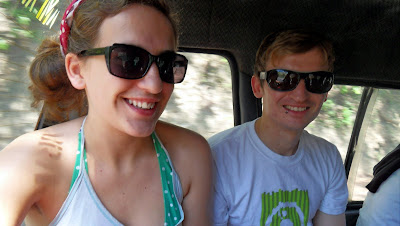
We're greeted by the few occupants, and once it's generally agreed that yes, we are headed for Prasih, and yes, this van can get us there, off we go, bowling at high speed past rice paddies and villages, dodging the scooters and motorbikes that overrun Bali, smiling and waving at motorbike drivers. And at the wife sitting behind him. And the little boy standing in the footwell between his daddy's legs. And not forgetting of course the sweet dark-haired little girl, jammed between her parents. And we can tell they're smiling back at us because not one of them is wearing a helmet. This destination is not recommended for weak-hearted British Health & Safety officers on holiday...

We're dropped off 25 minutes along the road, and make our way down a winding side lane to the beach. The 20-minute walk is lovely, through forested hills and past tiny farms, where women in conical straw hats bent over vegetable gardens raise their heads and call greetings to us as we pass, and sleek, tan cows and their miniature calves munch at the lush vegetation, self-absorbed to the tips of their pointy hooves.

The beach, when it slides into view from around the edge of a hill, is a gentle curve of tan sand stretching between two rocky outcrops. Palms crowd at the back of the beach and the line between forest and sand is marked with a colourful fleet of fishing boats. At one end, four or five thatched restaurants offer wooden sunloungers in front.

We choose one arbitrarily and settle into our little patch. The waitress comes and offers us freshly-squeezed pineapple juice. The sea is a bright turquoise blue and is rough at each end, by the rocks. In the middle is a relatively calm bit and this is where we swim. We have to choose our moment though, judging the right time between big waves to run out and float past the breakers. With uncanny timing, right after our first swim an old man approaches us with a fresh coconut, which to my delight he hacks open for us with a little machete, pops two straws in, and hands to us for a mere $1!

Sunlounger? Done. Fruity drink? Got it. Sand, sun and evil coral reefs? Done, done and... well, done. My second swim, I misjudge a wave and am royally and unequivocably dumped. As I go tumbling round wildly in the broiling sea, I remember that this is why I don't swim in seas with waves... Just before I'm finally able to swim up to the surface, I kick my feet out and graze some coral; I decide I've swallowed enough salt water for now so I retreat to lie on the chairs and inspect my wounds. They're not deep, but are very painful, and because they're grazes rather than clean cuts, all sorts of sand are making a home inside... We do the best we can with various stores of antiseptic handwash, wet wipes and seawater.


Lunch is served in the restaurant - "in" probably being the wrong word for what is essentially a few tables and a thatch roof plonked on top of a section of sand. I have grilled mackerel and manage very well, despite having to use those knife and fork things again... I was just getting the hang of fish and chopsticks!

For dinner that night, we've preordered king prawns at the restaurant down the road, from our hotel so, with my injury bravely limping on, we head back to town. We barely make it through the pile of grilled and battered prawns that's set before us, never mind the rice, salad and fruit.

This is an expensive meal - with drinks, it comes to a monstrous total of £15. For all five of us and 2kg of prawns. Yebo! I'm loving this place!