Showing posts with label birdlife. Show all posts

Thursday, June 21, 2012

Bangkok to Sungai Kolok


Having frozen on trains from south to north and back again, shivering beneath my thin standard-issue blanket, it came as somewhat of a shock when the aircon failed. They do say you don't know what you've got...


Boarding the train at Bangkok's Hua Lamphong Station (after a few hours sheltering and dozing at the hostel we stayed in on our way north), the warm air wasn't immediately apparent, but the 50-odd passengers and sealed windows soon saw to that. At each station, the conductors gathered outside my window, the centre point of the carriage, and fiddled about with something to do with the aircon, passers-by sidling up, arms clasped behind them, sometimes offering advice, sometimes not. But the aircon stayed off.

To escape the heat a little, I walked up to the restaurant car, the border between 2nd and 3rd class. There wasn't any aircon there, either, but at least the windows opened, and the joy of being able to stick my head out and wave to the occasional Railway Child took a lot of the pain away. (In case you're starting to question my stamina, I should tell you that we passed a digital temperature display that showed 37°C. Nobody should have to sit in a sealed glass-and-metal box for hours on end when it's that warm.) I wondered why I hadn't decamped to the restaurant car (which was called Bogie Gourmet - I'm not sure whether the name was a little harsh, or a little optimistic...) earlier (but of course, earlier I had a lovely, extra wide, cool, private seat to keep me away.)


We hit a big town at 5:15pm, just after the school gates had opened. The railway crossing held back a tide of kids on scooters. There was no apparent order, just a thousand scooters pressed against the barriers, the odd intricately-painted truck rising above the sea of uniformed students. Schoolkids sat on the edge of the railway tracks smoking or eating ice cream, sometimes both, one vice in each hand, taking turns. The station was decorated with the usual painted statues and potted bougainvillea, but also old tracks recycled into benches, and sleepers into bridges over a deep ditch, leading to the stilt houses beyond. 

At Patharan, herds of marigold-garlanded elephants heralded the station, and I wished for the hundredth time that I'd had my camera on standby.

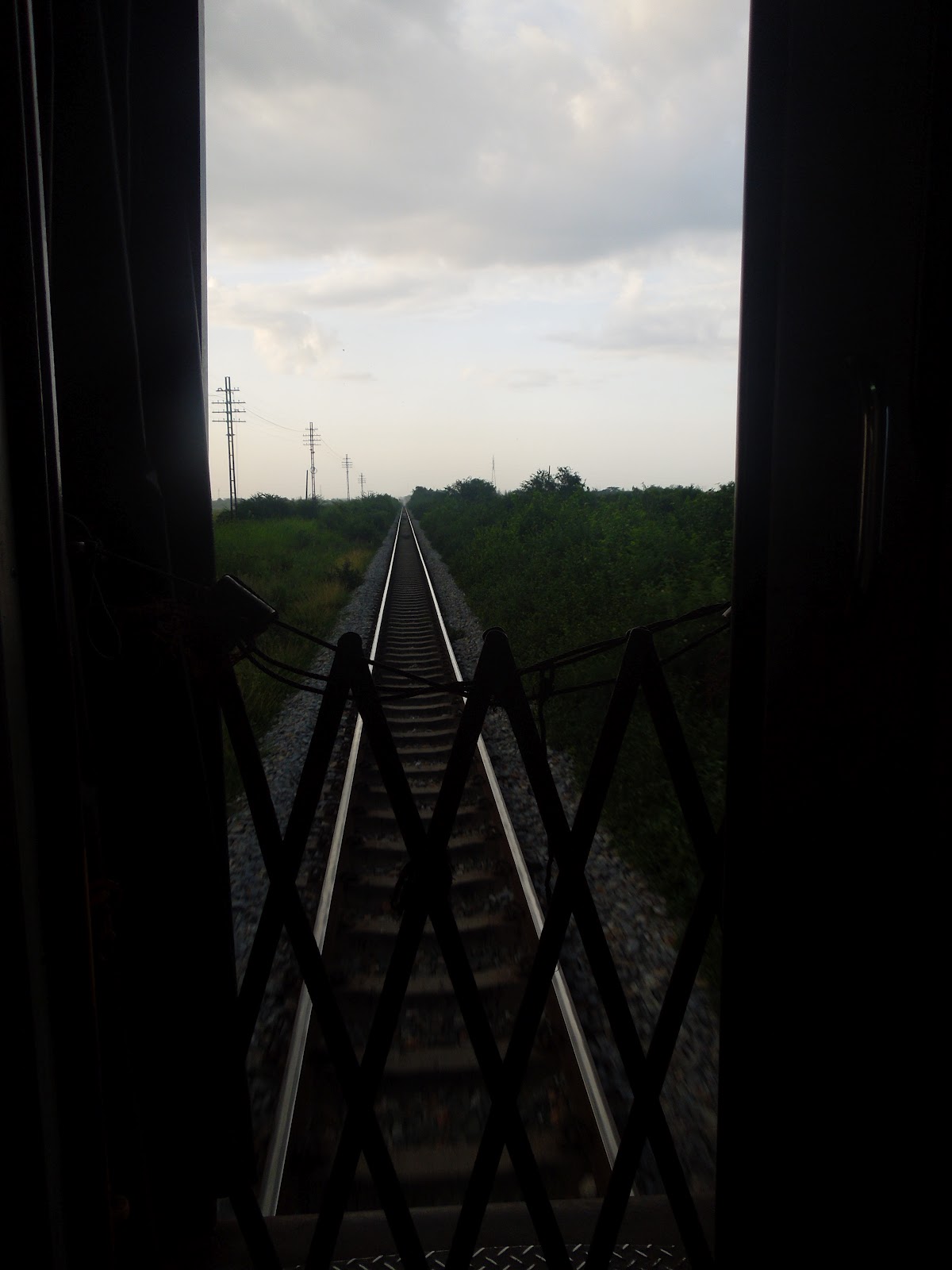
I walked to the back of the train, past First Class, and simply opened up the back door, looking out over the tracks as they whisked away into the distance.


We passed little stations without stopping; at each one, a man in starchy uniform dropped his flag as we passed and returned to his room. At most, the minute we passed, people walked onto the tracks, carrying produce or children, or in one case, a great big weapon, for who knows what use. Surely there's nothing in the scrub or the rice padi that would hold up to a metre-and-a-half metal-and-wood hatchet?


The further we got from Bangkok, the smaller the stations became, until we passed Ban Trok Khae, which was the first of many train stations that are simply tiny brick shelters with a sign - more like a run-down bus stop than anything else.

From a side door I watched the gathering sunset pick out golden stupas from the landscape, and cranes floating over waterways choked with lilies and lotus flowers. We passed a temple complex on a hill, lit up in the dusk by powerful lights, white and gold like an overwrought wedding cake. Thai people are certainly not the shy, retiring type.


. . .

In the morning, the scenery was more rural: rice padi fields and the occasional patch of bush and scrub. The karsts rose up in the distance again; it all felt quite familiar from the first trip through.

On our way to Hat Yai (around the time that my ticket said we should be arriving into Sungai Kolok), the attendant was changing seats into beds and gathering in blankets and pillows, when he started calling out in Thai, "something something something Hat Yai something." I looked about and everyone was nodding their acknowledgment, but thought, well, he's seen all us foreigners down this end, I'm sure if it's important, he'll come and try to let us know through sign language or something.

Hahaha. No, really.

Actually, I'm being a bit unfair here. He did come and check up on us. Approximately ten minutes before we reached Hat Yai, he came and looked at us worriedly for a bit. Then a neighbour took pity and translated for us: because there was no aircon or water in this carriage, we had to disembark in Hat Yai and wait for another train to come to bear us onwards to Sungai Kolok. When would this train come? Not sure, but we would get to Malaysia at about 4pm. No, 3pm. Well, maybe 4pm.

My friend and I looked at the other two foreigners in dismay - reaching Malaysia at 4 would mean missing the last ferry to the Perhentian Islands unless we were extremely lucky with transport. We asked the man if we couldn't stay on this train. Our translator explained there weren't any seats, but that he would try to find us one. We said, "We'll stand! Just please don't make us wait for another train!"

When we reached Hat Yai, the attendant came and took us and our bags to the next carriage along. He told us to wait there, but when he was gone, we thought that we might be more comfortable and have less chance of being kicked off if we were in the restaurant car. So off we went, piling our bags under the tables and sitting by the open window chatting to the other foreigners (who were at the end of a 6-month overland journey from Switzerland, so plenty to talk about).


After about an hour, during which time we hadn't moved, the attendant arrived in the restaurant car and said we could come and sit down again, so off we went again, following him to... a new carriage where all our fellow passengers were sitting. Yes, they hadn't meant "Wait for a new train", but "Wait for a new carriage." We felt a bit silly, really, for not simply getting onto the platform and waiting with the rest of them - I guess this is how tourists get a name for being difficult.


Anyway, the train finally set off again, heading into southern Thailand. We sat in our air-conditioned seats happily munching on green mango with chilli salt bought from one of the carts at the station.

Out the window, the scenery was still padi fields and small villages, the occasional rubber plantation flitting by. Wildlife too - well, mostly birdlife, really, but I did see some golden orb spiders, their bulk making them visible even from the train. Bee-eaters and kingfishers were common, and twice I saw fish eagles.

The scenery didn't change much, but the train stations did. When we reached Yala, an enormously long station, there were armed guards on the platform, and soldiers boarded our train, walking up and down the carriages talking to people for the remainder of the trip.


Thereafter, the small stations were guarded by soldiers, and were bound by well-kept metal fences, razor wire trimming the top. This being Thailand, of course, the fences weren't official grey, but were painted in bright reds, oranges and yellows.


The people changed at Yala, too - there was more of a Malay feel; women were still riding scooters, but now they were wearing tudong, the Malay headscarf. By Wat Chang Ha, mosques had become as visible as temples. The military presence grew - young Thai men in black vests and big boots, casually sporting rifles - they were set apart from locals by their paler skin, the locals being farmers and labourers.


Finally, finally, we came to Sungai Kolok, where we crossed the tracks (and by the way, I am all in favour of this method of crossing through a station - no lifts, elevators, stairs, tunnels or nasty smells in dark corners...) to the carpark to take a taxi to the border crossing, a few hundred metres away. There we left Thailand, and crossed a 50-metre No Man's Land, which spanned a small river - which, incidentally, was being crossed without any restrictions by the villagers who lived on either side :)


On the other side of the bridge, we returned to Malaysian soil.


Saturday, March 24, 2012

Turtle soup and other No-Nos

We left from the jetty at Sandakan in high spirits, ready for the 45-minute journey across the Sulu Sea to Turtle Island National Park. Past the super-modern angular mosque and the pretty water village; past a Philippine cargo ship and low houseboats waving laundry like shapely flags. The headland disappeared behind us, while upfront darkness loomed - perhaps you might not have felt its looming, but as someone who feels queasy on a bridge, it loomed. Soon the rain came, spattering the water into texture, forcing the boatman to lower the canvas sides. We sat in darkness, noisy darkness, the sound of the engine filling the small space. Looking out the back, just grey sea, grey sky, and in true Sabah style our lime-green boat.


After 45 minutes, solid land started appearing again - little grey islands, dressed in grey trees and beige slices of beach. And then the air cleared a little, and the grey sea turned to bright turquoise, the coral causing dark hiccups as we slowed, and stopped, right on the beach. Someone leant a wooden stepladder against the bow and we all stepped prettily down onto the sand. Well, mostly.


Turtle Islands Park is made up of three small islands (yes, really) on which there are turtle sanctuaries (honest) and which have collectively been a national park for nearly 35 years. It lies right on the border, so that the next island you can see from the beach is Philippine. Southern Philippines. Where they still eat turtle soup, and munch on turtle eggs for breakfast. It hasn't been an altogether easy ride for Sabahan environmentalists... Pulau Selingaan, the only island with tourist access, is visited by 15 to 20 Green and Hawksbill turtles every night of the year. As we walked up the beach ot the cabins, we crossed over their curious tracks - like the tracks of a small tractor that's dragging a body behind it, say - and (repeatedly) fell into the cavernous holes that used to be nests. The reason these are holes and not nests is, of course, entirely eco-friendly: a team of rangers waits up every night, stealing the eggs as they drop from the mother turtles, and carefully reburying them in a safe hatchery, then, two months later, releasing the newborns back into the moonlit sea. It's all a terribly romantic job and reignites my 8-year-old self's desire to be a marine biologist.


One side effect of this protection is that the beach is wonderful, and only inhabited by the twenty tourists staying on the island, while the snorkelling is amazing - just a metre or so off the beach, you better pick up your feet, because otherwise a multi-hued parrotfish or a bright blue starfish is going to get you. Or, arg, one of the millions of very healthy-looking sea slugs. Really. It took me about an hour to persuade my sister to go any further than the end of the sand.


Apart from dodging the vicious little beasts, I spent the late afternoon sitting and watching herons hunt amongst the rockpools, and raucous kingfishers swoop in on unsuspecting prawns in the shallows. It's well worth a visit, even if turtles don't rock your boat. Which they do. Obviously.

So at night, after dinner and a well-made video that roundly castigates the Philippines for being such turtle-murdering meanies, we sit and wait. It's very dark outside the main building, so as not to put off the turtles, but we can see the torches of the rangers going back and forth until one cries out "Turtle!" We all grab our cameras and hurry down to where he crouches with a bucket, grabbing each soft, round egg as it falls from a 1.5 metre Green Turtle, a beautiful creature who's in a birthing trance and isn't in the slightest disturbed by the fifteen tourists oohing and aahing over this encounter with a real-life dinosaur.


The ranger watches her carefully, and as soon as she's rested he shoos us off the beach. We see a couple of other turtles in the moonlight, but only one is allowed to be disturbed each night so we let them be. Up to the hatchery where we watch the 79 eggs being re-buried in a lizard-proof hole, carefully labelled with the date, species, number of eggs, and number of clutch since January 1st - 869 clutches have been stolen and coddled so far this year. Our pleasure is somewhat reduced when the ranger tells us less than 1% of these turtles might actually reach adulthood. But it's a start.


Finally it's back down to an empty stretch of beach to watch a bucketful of babies ("...and here's one I prepared earlier!") being returned to the ocean. Almost all of them waddle frantically straight for the torchlight being shone on the water, but three head for us and I'm permitted to gently turn one around and set him off in the right direction. He's soft and grey and his flippers smack my fingers, and I just know that he's going to be one of the 1%.

Saturday, September 10, 2011

The Lower Kinabatangan

Perhaps the most eye-catching thing about the jungle in north-east Sabah is how little of it is left to catch the eye. On the three-hour drive east from Ranau, the commonest view is one of the oil palm, twenty-year-old dark green hulks, pale and tender babies, a spiky carpet from roadside to horizon. Palm oil is the difference between squalor and wealth for many families - from a single hectare, harvesting twice a month, a farmer can make RM2000 a month with ease, in a region where the average wage - if you're lucky enough to have a paid job - is around RM500. It's easier to condemn the palm oil industry when it doesn't mean the difference for you between bare subsistence and an education for your child.

However. Most of these plantations belong to Big Business, not Little Farmer. They replaced primary jungle with a non-native weed. The palms are a perfect breeding ground for mosquitoes, and malaria and dengue fever are on the rise. Pygmy elephants, unable to cross the fenced and guarded plantations, are trapped in small pockets of forest. The birds are badly affected - in primary Bornean jungle, you'll find more than 220 species; in secondary forest after cultivation that drops to around 60. Palm oil plantations support ten. Just ten.

Palm oil is in everything you use, from shampoo to lipstick to cooking oil. For the sake of my view, which is far better when it's of jungle, please check the label next time you shop, and buy the product that doesn't contain death and destruction!

Besides, if your lipstick's got palm oil in it, then your beauty regime is killing orangutans, and orangutans are quite simply the most touching creatures I have ever had the privilege to meet.


They're being poisoned, starved, maimed and orphaned in large numbers by the plantations, but if they're lucky, they'll be found and taken home by the Sepilok Rehabilitation Centre. I wasn't originally going to go to the Centre - I'd had visions of a cramped zoo. But what it actually is is 43 sq km of forest, and a team of amazing, loving, foresighted people, who gently coax traumatised orangutans back into an independent life in the forest. Starting in the orphanage, the babies and young adults are fed daily at a series of feeding stations, each one deeper into the forest, each one serving smaller amounts, encouraging the orangutans to forage for the rest of their meals. So far, every orangutan has become independent - some are never seen again, some return now and then, to show off a new baby or say hello to a ranger.


Part of the Centre's income derives from Feeding Station A, which is open to the public. You watch from a separate platform as a ranger brings milk and fruit to a platform in the trees, but the orangutans have little care for the separation, and as I was standing there, a young male came swinging onto the boards, loping so close to me I could have cuddled him.

After the sanctuary, we set off on a 90-minute drive south, to a jetty on the Kinabatangan River, the second-longest river in Malaysia, and one of the best-protected reserves - not that you'd think so to look at it. Even here greed has won over thoughtfulness, and in between ten pockets of secondary growth forest, the palm oil plantations are huge. In some places they start right on the riverbank, but there's positive news - the WWF has wrested back control of a 100-metre corridor between each forest pocket, and in most places has ripped out the palms and replanted indigenous trees, allowing wildlife to move more easily. The farmers are not happy, but they've mostly submitted.

At the jetty, I and my co-travellers board a speedboat to travel 45 minutes upriver to "Uncle Tan's Wildlife Camp."


The website and other travellers have warned that it's the roughest camp on the river, that there's no luxury, that it's extremely basic - in short, that it's no 5-star hotel. But I find it far above my expectations. Yes, the accommodation is a mattress under a mosquito net, and you share a cabin with five other people. There's no bathroom as such, and you wash from buckets of river water in the open air. On the other hand, the buildings are wooden and on stilts; beneath them is moss and water, turtles, fish and monitor lizards, and above is the forest canopy, filled with birds. There's a big eating area with a staff cooperative that sells cold beer (there's no electricity except for a few hours in the evening, but they've got ice). And everything's spotlessly clean, which is a little short of a miracle in Sabah.

And it's beautiful and quiet, and on my first night a spotted civet pauses in its prowl less than a metre from me, watches me for a minute, and then silently slips into the forest.

The guys who work here are passionate about conservation and the forest, and knowledgeable. One is studying birdlife, another patrols the nearest corridor in his free time to make sure farmers are staying away. It's all a world away from the Hyatt, my first experience of Borneo, and all the better for it. We're lucky enough to see four orangutans in the wild, and hornbills, and an owl during his nighttime fishing. Eagles glide overhead, and down on the forest floor, we get to see tiny frogs, and chameleons, and what the ranger insists on calling a trilobite - it certainly looks like the fossils, but aren't trilobites extinct? This place is pretty prehistoric - I wouldn't put a live trilobite past it!


I could have done with a few more days, but had to make do with the two nights of boat rides and jungle trekking on offer, before getting back to the village for work...

Thursday, December 31, 2009

In which our heroine goes shopping

On Saturday, with Lisa back at work, I spent the whole day lounging on the verandah in my pyjamas with several cups of tea, watching the visitors to the bird bath. There were a lot of them I couldn't identify. Some I could guess, like a shy dove, although he differed from African doves with his black mohawk and speckled shoulders. Wader-like loners popped in, princesses on their long limbs, taking flight at the least provocation, unlike the others, to whom I might as well have been a statue for all the attention they gave me.

The most regular were completely unrecognisable to my untrained eye; wearing way too much blue eyeshadow, the honeyeaters arrived in small flocks, trilling to each other as they played in the water.


Other unfamiliar birds were easier to name: bright white cockatoos with a spray of yellow feathers on their heads, hanging upside down from palm fronds, screeching merrily at each other and me. Another parrot - the Rainbow Lorikeet - also made frequent, gaudy appearances - green, yellow, red - as though they were pictures in a very neat child's paint-by-numbers book. They always rocked up in pairs, the better to enforce their clear status as the undisputed mafia thugs of the birdbath, viciously attacking meeker supplicants with maximum noise and a great deal of wing action.


At dusk the songs of all the birds, thugs and princesses alike, combined in the park before Lisa's verandah to make a sweet bedtime lullaby, flocks whirling overhead until they'd found a suitable site for the night. It was a very peaceful end to the day.

On the Sunday we drove to a mall to do some clothes shopping. Every single pair of jeans I own has recently sprouted unsightly tears and holes and I needed some replacements. It was a bit of a surreal experience really. Just imagine: nobody stared. Nobody shouted "Big size here!" at me. I didn't get ushered out a single shop by an anorexic salesgirl, anxious that I shouldn't sully her store's good name. And oh! Oh! The pleasure in being allowed, nay, invited to try things on before purchasing... I left with my ego intact and my wallet light!

Plus, on the way back, Lisa stopped alongside a golf course, and I got to see my first kangaroos, lazily lolling on the grass as golfers whacked balls over their heads...

That evening I cooked a roast chicken. What pleasure to be able to eat free range again, and to know that the veggies came from down the road instead of across the seas. We ate outside on the verandah by candlelight, birds cooing in the trees, mozzies gnawing on our toes... heaven...


Koalas: 0
Kangaroos: 6
Lifers: 10. 11. No, wait... 12...

Saturday, June 13, 2009

Pointing, And Why It Is Unacceptable To Do So At A North Korean Commando

Today I stepped over the line dividing North from South, and while Those Red Commies were thin on the ground, I did get to drool with Jacquelyne over a six-and-a-half-foot square-jawed American Patriot. Oh, those stereotypes - make life so much easier!

We left EV in the morning to get the bus down to Seoul, where we exited the subway into a hotel the likes of which my tatty little eyes have never before seen. There was an entire floor of jewellery stores where the window displays included CCTV cameras the size of a large cat, focused on the precious goods, and the chairs artistically scattered in the enormous lobby were flanked by great palm trees. It wasn't even one of those hotels trying to blind you into thinking they were tucking up Brad Pitt in their main suite that night. It was one of those that really doesn't need the bling to make you understand that this is a place you do not belong unless you're only in Seoul to buy your daughter her own jet because the family one is getting a little small.

The agency on the 3rd floor took all our passports and photocopied them for their files. We had already supplied the details a week earlier so they could be passed to the South Korean and US armies for approval. The woman at the desk quickly checked that we had all conformed to the intense dress code, and then we were off on a bus out of Seoul and into the north. The first stop was lunch, and I laughed and said wouldn't it be funny if they took us to English Village, which we would pass on the highway. Actually it wasn't English Village, but a buffet place at the bottom of our hill. Look who's laughing now. After showing everyone else our Hollywood-style sign up on the hill, we were off again, following the highway that runs alongside the Han River. Just a few metres after rejoining the highway from the Paju turnoff, the Han met the Imjin, and the view over the river, like political magic, became North Korea.


We first visited Imjingak Station which is the furthest that South Koreans are able to go. Cait and I were both horrified at the extent to which South Korea has taken a place of great sadness where elderly women go to leave tributes to the spirits living in their hometowns, so far away in the north, and turned it into, well, an amusement park, complete with loud muzak and tacky souvenir stalls.


 We were able to overlook Freedom Bridge which was destroyed in the Korean War and rebuilt to carry thousands of prisoners of war back to their respective sides after the ceasefire. In the photo on  you can see a wooden bridge which takes South Koreans to a barbed wire fence on which they pin colourful ribbons asking for information on lost family members, and prayers for hometowns and for peace.


Back on the bus, we continued down the Freedom Highway (!) to the first military checkpoint, at the gates to Camp Bonifas (named for a victim of the Axe Murder Incident.) Driving past the World's Most Dangerous Golf Course, a one-hole course surrounded by a minefield, we were offloaded into a hall where a short presentation raced us through the Korean War and its aftermath, and told us the rules of this rather surreal tour. Listen to the soldiers; walk in two strict lines; don't point; don't react to North Korean soldiers; don't look anyone in the eye; don't touch any equipment; only take photos when told to. Many of the rules were obvious - pointing might look like a gun - or at least enough like one for the KPA (the North Korean Army) to react. Others, like not wearing slops or torn jeans were a bit more obscure. A friend joked that slops were banned because the sound of them slapping on the steps imitates gunfire, which isn't great in this edgy environment. Apparently, though, it's because in the past the KPA used photos of sloppy tourists as propaganda to prove to the North Korean people that South Koreans and westerners were desperately poor - not realising that these days, the more rips your designer jeans have in them, the more money you paid for them...

Exiting the building we were loaded onto official JSA buses for the short journey to the southern demarcation line where we passed checkpoints overlooking three 10-foot fences topped with barbed wire and alarms, enclosing a 100 metre strip of dead land loaded with landmines. A long stride from the first days, our army escort told us, when sticks pushed into the ground were attached by wires to tin cans filled with pebbles to warn patrols of incursions.


The landscape was overgrown and lush, giving way occasionally to rice paddies. There are two villages within the Demilitarized Zone, maintained to enable a smooth return to peace should war ever be over. Each side has one village, and the farmers grow the best (and most expensive) rice and ginseng in Korea, the taste improved by the fact that there is no pollution to corrupt the crops. Benefits of living there include vastly inflated prices for crops, and no taxes. Then again, farmers move in pairs so that if there is an attack - and these are common, even extending to kidnappings - one can escape and warn soldiers. Villagers are under strict curfew, and the only reason they generally leave is for children to attend school in nearby Munsan (the nearest large town to the DMZ). They must be in their homes for 250 days a year to maintain residency. Not a home I'd personally feel at home in!

Another unexpected benefit of the Zone is the proliferation of birds and animals, living peacefully and undisturbed by the massive development in other parts of Korea. One of my friends and I were excited to see what we think was a Red-Crowned Crane, but sadly no Asiatic Black Bears or Siberian Tigers.

We soon came to the JSA - Joint Security Area - a small collection of buildings on the central demarcation line. One side is North Korean (grey buildings), the other South Korean and UN (blue buildings). We were taken to a small traditional pavilion from where we could see and take photos of the North Korean administrative building, Panmunjak. Here I proved myself incapable of not pointing, although I did get a gruff "Ma'am, please do not point." from the 6-foot Patriot, which was cool. Pointing once was silly. Pointing twice, however, had me exiling myself voluntarily from the edge of the pavilion and sitting on my hands in the stairwell. This decision was helped along by the North Korean watching us through binoculars.


You can just see the guard in the photo above, but when you look at the zoomed-in photo below, you can see the second pair of binoculars in the window. No matter your thoughts on Western propaganda, and Stalinist dictators (or vice versa), it's creepy.


From the pavilion we also looked down on the blue buildings that serve as meeting places for the two sides. The South Korean soldiers standing at the end of the buildings in the picture below are facing the North Korean side. The one on the right is half protected by the edge of the building - this is so that he can get out of the line of fire if the one in the centre is shot down. Notice their stance with fists curled at their sides - this is the Ready Position for Taekwondo, which every soldier has to become expert in.


From the pavilion we descended through the deserted visitors' centre to the equally deserted central quad, containing 5 long huts stretching between the sides. We entered Building No. 3, the main building where all talks take place. Inside, two South Koreans stood guard. Translation booths at each end overlooked a well-polished table down the centre of which microphones marked the official border between North and South. A UN flag was set on the table. Other flags too once stood here, including South Africa, remnants of past peace talks, until a North Korean guard leapt onto the table and wiped his bare feet with the American flag. Since then, the flags have been relegated to a glass frame over the South Korean translation booth.

The two South Korean soldiers stand in a constant state of readiness when there are civilians present. Wearing aviators, helmets and uniform, the clenched fists give them an air of menace - more so when the more you try to make them laugh or even twitch the more they resemble wax statues. We couldn't resist taking photos with them, silly as I felt standing next to a breathing statue (although the breathing part is questionable.) Both soldiers were giants for Koreans, and our American Patriot explained to us that the North Koreans used to use such well-respected military tactics as sneaking into the building before meetings to lower the chairs of the other side, so that they could look down on their ideological opponents, and wearing high heeled shoes. So it became US policy to only use soldiers 6 foot and taller within the JSA... The Koreans cannot possibly compete - in fact, as the Patriot told us with a grin, even the chair-lowering didn't make them taller than the Americans. Now that control of the JSA has been handed over to the South Korean army (only 5% of soldiers inside the DMZ are American) soldiers are still specifically chosen for their height, while shorter soldiers are assigned to fence cleaning duties...


Back on the bus, we drove up to one of the guardposts in the JSA, overlooking the bridge to the North Korean DMZ. From here we were able to see Gijong-dong, or Peace Village, the motley collection of high-rise buildings known to everyone else as Propaganda Village. Funny story, here. You know the common knowledge - small man, big... car. Well, a few years back the South Koreans gave a flag to their villagers in Daeseong-dong. Of course, it needed to be erected on a pole 98m high, and the flag was equally enormous. So, because this is what grown men do these days, a Northern flagpole was installed, the Southern one was made a bit taller, and the North Koreans responded with a 160m flagpole - the tallest in the world - topped with the biggest flag currently in use. Our South Korean guide cast his eyes heavenwards in a brief comment on the silly North Koreans, then muttered "Anyway, their flag might be longer, but ours is wider" before swiftly moving on.

Men.

The modern-looking buildings are actually just empty shells; people arrive every morning to walk the streets, and leave in the evening, to give an appearance of industry. In the 90s, the empty buildings were used as stands for massive speakers which blared propaganda over the border, encouraging South Koreans to defect. After a few years, the South Koreans retaliated with their own speakers, the size of a house, apparently, and shot back at the North with... K-Pop! Which I think is possibly the funniest and most evil retaliatory shot I have ever heard of. Eventually the resultant din became too much for residents and soldiers to bear, and the South Korean president negotiated a pause in auditory hostilities in a historic visit to Pyongyang (the Northern capital).


From here we drove down to the guardpost the first guardpost was guarding. This second guardpost was at the edge of the Bridge of No Return - so-named because after the war, prisoners were exchanged here, and as they crossed the centre, they knew they could never return to the side they had just left. In 1976, the US complained that they were unable to see the second guardpost (I apologise for the amount I am going to use that word) from the first guardpost because of tall trees. Meanwhile the second guardpost was clearly visible from 3 KPA guardposts. This needed to be addressed, clearly. So one morning the US army pulled up to the tree, which was by the bridge leading out of JSA to North Korea, and started cutting it down. The KPA went mental, and, in stopping the tree-cutting, chopped up two US soldiers with axes.


Known, appropriately, as the Axe Murder Incident, it was followed up three days later with an enormous operation involving more than 800 soldiers in which the tree was finally cut down in front of a small group of silent North Koreans.


1976 above; 2009 below:


The whole incident means that the UN forces now need permission to break a twig off the tree. And where previously the whole JSA was open to both sides, now the demarcation line is rigorously enforced, apart from within the central blue huts.

From the Bridge of No Return we were taken back to Camp Bonifas where, in a spectacular display of the incongruity of the DMZ, we spent 15 minutes wandering around the Most Dangerous Gift Shop In The World. Alongside the usual jewellery and postcards were tiny kids' dresses and trousers in camouflage, and t-shirts proudly declaring "DMZ: Demilitarized since 1953." Lighters and fridge magnets in the DMZ colours, Cokes and Snickers bars in the fridge, golf balls for your safe home course, pieces of wire from the fence... Ever so slightly distasteful!


Driving out of Camp Bonifas and away from the gun-filled Demilitarized Zone and the segregated Joint Security Area and all the other misnomers, I was pleased to have been there, though slightly disturbed to have been on an organised tour to such a dangerous and sad place - surely it belongs in a museum, and in photos, rather than in real life, here on my doorstep?