Showing posts with label shopping. Show all posts

Sunday, April 1, 2012

Shop Shop Shop

I'm in ecstasy. I think the food currently on my table is the best food I've ever eaten - certainly the best Indian. The naan is smoky from the tandoor, the paneer masala has the perfect level of spice. It's a completely unpretentious cafe/restaurant in a back road of Kuala Lumpur, and I will always remember with deep love the woman that sent me here. I'm kind of glad I don't live in Kuala Lumpur, because if the shops didn't take all my money, this restaurant would. In the hopes that they will also take all of your money (which would admittedly be difficult, as my whole meal cost me about £1.20): Sangeetha Restaurant, on Lebuh Ampang, round the corner from the Masjid Jamek LRT station. Go.


I feel like I've been from one end of the shopping scale to the other today, and walked every inch of it. I've bought a new camera in a Korean-style electronics mart, walked awed through a luxury mall that had an aquarium in the basement and a 5-star hotel in the attic, bartered at a flea market, wandered through a very sedate Central Market (like an over-civilised Grand Bazaar in Istanbul), bought spices and incense using only hand signals from an Indian woman with a cart, and been dressed in a saree by an over-ambitious shop assistant in a fabric shop in Little India (there was a short silence and then he slowly started unwrapping me again.) I'm fairly certain I spent most of my salary in one day, and on return to Sabah will be eating instant noodles until the 27th of April...

But look at where I stayed! Kuala Lumpur is a remarkable city in some ways - the hustling crowds of the cityscape suddenly give way with no warning to quiet streets lined with century-old shophouses. My hostel was in a converted shophouse, the middle one in the picture below; although 'converted' is stretching it a bit. The front was immaculate, the back they had gutted and replaced with some oddly beautiful modern architecture - steel and concrete and brick.


And they had awesome doors on all the rooms too:


Yep, that's me! Emily! My room! (It also really helps for when someone new arrives, tells you their name three times, leaves, and you promptly forget their name and then bump into them at bedtime. Sneaky.) (In case you were my roommate, I totally remember your name, it was that other guy next door I'm talking about.) 

Wednesday, January 11, 2012

Shopping in Sabah

Not for me the strip-lit, noisy, impersonal malls of England - when I shop for fruit and vegetables in Malaysia, it's at the marketplace in town, a mass of brightly-dressed women, each crouched beside a mat that holds the produce of their little plot of land in the village - a few bundles of rambutans, a bag of wild rice, perhaps, or some little packets of red chillies, the fewer the chillies the higher the potency.

When I drive out to the villages I have another option: the roadside stalls. Often built of scavenged wood, they are a representation of one of my favourite aspects of living here in Sabah. The owner of each stall will visit it in the early morning, bringing whatever produce she has harvested from her land the day before. She will string up each bunch of bananas or packet of chillies on its own nail, and price it - usually one ringgit (25 pence) per item. And then she will leave it, return home to work. A customer will come along, choose her item, and tuck the ringgits into a rusty tin or sometimes a custom-made wooden box - my favourite cashbox so far is an old baby's bottle, a slit cut into the side, nailed to a wooden post. No one steals, no one leaves without paying. At night, the owner returns to collect her cash and take back any unsold produce. I simply cannot imagine it working anywhere but here.


Saturday, September 17, 2011

The Big City

Discovering you're a country hick is never fun.

Arriving in Kuala Lumpur on Friday, my first thought was, gosh, look at that - they've got trains. Then I mentally smacked myself, and boarded the express train to the centre of town, where I gaped at the existence of internet-connected tourist information booths. A taxi drove me through buildings taller than three storeys, and past beautiful old mosques. And I stared.

My first action at the hotel was to ask where the mall was, having some shopping that needed to be done (apparently in Kota Kinabalu, file dividers simply do not exist, and shop assistants repeat my words like I'm a crazy person. "File divisions?" "No, dividers." "Divisiers? You mean a document folder?" "No, I mean a divider, and if I meant a folder, I would have picked up one of those pretty folders on prominent display behind you.") The man at the desk suggested 6 malls, all within walking distance, and offered to call a taxi to take me to several more. I blushed and walked across the road to the Pavilion, Asia's Premier Luxury Mall, and owner of the Tallest Liuli Crystal Fountain in Malaysia, as endorsed by the Malaysia Guinness Book of Records. Truly. I'm not about to admit that I don't know what a Liuli Crystal Fountain is, because the look on my face already marks me as the hick I am.

The mall is about 50 floors high and probably covers more floorspace than the whole of Kota Kinabalu, and it has a Japan Street, which has a two-floor shop devoted to plastic cameras, and authentic Japanese street food stalls. There are two art galleries, and one hundred and seven restaurants and cafes. Four of those are Starbucks. Actually, I think it might have been three, but I got lost and passed one of them twice. There are two car dealerships - Bentley and Jaguar.

I'm overwhelmed, and not least because I've just seen two women dressed in black sacks with a mesh covering their eyes buying sexy lingerie. 

I get lost.

Then I find the Nando's in the basement, and everything becomes alright again - and it's even okay that the waiters say "Yebo!" with a thick Malaysian accent, because Oliver Mtukudzi is playing on the stereo, and the vegetarian burger tastes of home...

Thursday, February 18, 2010

Spiritual tourism

On my last morning in Luang Prabang I woke up at 6am and walked down to feed the monks. Yes, I know, sounds like a zoo, doesn't it? It's actually a very old tradition. As I walked down towards the temples, women passed me at a trot, long bamboo sticks over their shoulders with baskets at either end. As they slowed next to me, I could see the banana leaf packages inside holding rice, and the women held these out to me, calling "Feed monk? Good karma, lucky. Only 5,000 kip!" I felt a little nervous of pretending to join in on this spiritual journey, but when I got to the main street I saw quite a few tourists kneeling on grass mats among the Lao, so I let a seller persuade me to buy a plate of bananas, and knelt in the dust. The dawn was only just breaking when the first sunrise-coloured robes appeared at the corner. Each monk carried an ornate silver bowl around his neck, and as he moved down the waiting line of devotees he paused long enough for each woman - for they were mostly women - to place a food offering in the bowl.


My bananas weren't as popular as the sweets the next lady offered - at least with the younger monks - but they went quickly enough, and I straightened up to watch the rest of the procession pass by. It was fascinating to see the long line of monks, not looking at the people and especially avoiding any physical contact with women.


Although, once again, I felt like I was taking part in a Disney play specially put on for me, when I left and walked down a side street, all the women offering food were Laotian, and it does strike me as a good way to feed those in the temples while spreading the burden of support over many shoulders. For the monks, it constitutes their only meal of the day, eaten at lunchtime after chores, and often shared with an attached orphanage or school. Some of the women were Hmong and likely to be Christian, so perhaps this is seen as more of a cultural tradition than a religious one.

Anyway. Suitably reassured, I walked down to the food market nearby. The food market is two or three streets, quite narrow, lined in the mornings by sellers from the surrounding province. The narrowness of the lanes does not, however, prevent scooters from entering; add in the surprising amount of live produce, the chatter and the loud bartering and it makes for a noisy experience.


Welcoming though - every time I requested a photograph I was answered with a smile. I felt something bang into my hip once - it was a basket being carried by a grey-haired lady with a deeply lined face. She held up her hands and smiled in apology and as I smiled in return she grasped my arm and patted my face, laughing to the other women.

The food on sale was mostly vegetables, many of which I couldn't recognise, green leaves and flowers, alongside deep purple eggplant and the pink dragonfruit I'd come to recognise in the fruit smoothies I had every morning on the side of the road.


Some of the fishermen's wives were selling balls of river weed from wicker baskets, eaten much like seaweed is elsewhere in Asia; it looks just like the weed I used to drag out of the pond as a kid and dry in strips, and probably tastes much the same, too (as a kid, I was smart enough not to eat these things - as an adult, not so much.)


There were stalls selling dried strips of pale meat - less like biltong than leather straps. The small meat section had anonymous cuts of meat sharing space with such joys of the meat-eater's world as pigs' ears and testicles; hordes of flies were kept away - though only just - by women waving plastic bags tied to sticks. I hurried past. I paused to watch two women squeezing honey from a comb into a bucket.


As I was crouching to photograph the scene, something in the foreground caught my eye, which I'd only heard of till now: two splayed and roasted rats!


Laos is well known among conservationists for its fervent consumption of anything that swims, walks, slithers or flies, regardless of the animal's position on the endangered list. It's why generally I haven't seen much wildlife here, apart from the Rivertime Lodge where the land is protected. Although the authorities are clamping down in an effort to make Laos an eco-friendly county (eco-tourism is big business here), it's still possible to see, in certain markets, monkeys, spiders and snakes sold as meat. The rats I saw were probably just common field rats though. There were also grass snakes and little piles of beetles neatly laid out on mats.


Apparently not too long ago some wildlife experts discovered a species of rat thought to be extinct before they saw it roasted at a market. It hasn't been seen since, either...


I caught the midday plane back to Vientiane, where I was treating myself with a stay at the Vayakorn Inn. All hardwood floors and dark Laotian furniture, it's not a five-star soulless hotel, but it's pure luxury for me after sharing a bathroom with 5 boys for four days! The view from my balcony takes in the magnificently ugly Cultural Hall which was built, clearly, by a big fan of gold kitsch. It's very central, so I take a walk around town as soon as I'm settled in.

Monday, February 15, 2010

Fairyland And Its Inhabitants

Early on Sunday morning I packed my bags and left Rivertime for the airport. On the 40-minute drive, Joy told me of his great happiness at entering the army in two months' time. So very different to South Korea where most men would do anything to get out of serving... With Lunar New Year and Valentine's Day falling on the same weekend this year, the streets were awash with red - lanterns for the new year, teddies and roses for the lovers, everything sold together from tiny stalls on the roadside. There was one particularly blessed woman somewhere in Vientiane, whose boyfriend sat in a tuk-tuk in front of our car, red and white balloons billowing out the back and completely obscuring the door. Even the dress code matched the event, with a red t-shirt or dress atop every scooter. I was rather glad to leave the American-style commercialism behind at the airport gates!

I quickly cleared check-in and went through to the waiting lounge, a grid of hard plastic chairs looking out to the runway where a plane was waiting. Not, surely, my plane, for I was flying the national airline on their busiest route, and this was a teensy tiny propellor plane.


With a lovely flower on its tail, yes, but still teensy, nonetheless. I sat and waited, but no other flights were announced and no other plane showed up, and the pilots walked through, pushing the unlocked doors open to the tarmac, and then a sweet lady in her silk uniform told us we could now board. So we all did, walking across the tarmac to get to the 5-step ladder. Which of course I have done before at other small airports. I have, however, never had to duck to get in through an aeroplane door... My window seat was right in the middle, right under the wing, and next to the wheels.
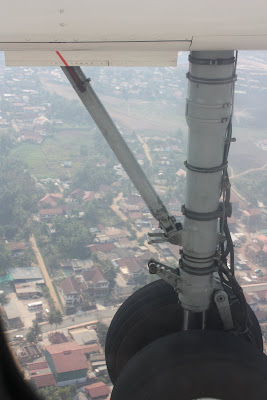

I started to understand why other travellers were wary of flying Lao Airlines, but in the end it was a perfectly pleasant, very short flight over valleys and mountains and bright red dirt roads. As we descended into Luang Prabang, the Mekong stretched and yawned beneath us, curling around the little town, gold temples reflecting the morning sunlight into my eyes. Luang Prabang used to be a distant colonial outpost for French officials who, for one reason or another, never wanted to go home again. In my 40-minute flight I leapt over a month's travelling. It used to take longer to get from Bangkok to Luang Prabang than to go from Bangkok to France by ship! Perhaps as a result of this unimaginable distance, the officials who settled here eventually turned it into a beautiful village in the French style, with shuttered two-storey cottages lining a narrow street, and a boulevard running above the Mekong with space for a cafe table or two.


The town mostly fills the peninsular space between the Mekong and the Nam Khan, a river that joins the Mekong here. On the 15-minute tuk-tuk ride to my hostel, I started to see the chaotic Asian traffic I missed in the Vientiane countryside. There are scooters and tuk-tuks everywhere, although it's still far from the stereotypical Vietnamese streetscene. I was barely at the hostel long enough to dump my bag on my bed, and then I was off to the main street, Th Sisavangvong, named after the king at the time of independence from France. Lovely.

Of course, it has the usual ebullience of Asia, but the allure of the town is in the bougainvillea creeping over the carved wooden balconies, and the open-fronted cafes. Asia shows her motherhood in the street food sellers - I buy a coconut dumpling straight away from a man who says he has 7 children to feed, although at least in the drawing on his cart they all have very smiley faces - the friendliness of the people - the dumpling seller chats to me for 5 minutes then makes me another one because he sees the sticky smile on my face, then tries to refuse to let me pay my 10p - the brightly coloured tuk-tuks everywhere - often with movie scenes painted on the sides.


Of course, because this is the 21st century, all the houses and cottages are now massage spas and restaurants, tour agencies and money changers. This is a town where people feel comfortable leaning over from their table to contribute to your private conversation, as if because we're all tourists we're the same, and should help each other out with tips and warning tales. Every Lao person is seemingly in the tourist industry, from men guiding the tours, to women giving foot massages and selling silks, to the children selling trinkets when they're not at school. At least the kids do go to school - when I tried to fob off one persistent ten-year-old with "maybe tomorrow", she retorted "Tomorrow school, every child learning learning. You buy now."

I did "buy now" in the end...

I retreated to my room for a late afternoon siesta but I'm back at 5:30 for the night market, a sea of silk and silver that shuts down Th Sisavangvong.


I eat street food, which in this fairytale land means a vegetarian baguette and a fruit smoothie, and wander about talking to sellers and deciding what I would buy if I were a millionaire. I pass the boat pier where a rotund man sporting an improbably moustache suggests I might like to take a boat to the other side of the river, "with your boyfriend" he says. I tell him I have no boyfriend. He and a nearby tuk-tuk driver laugh and shake their heads at the shame of being an elderly spinster. "That pity," the boatman says, "but don't worry, for today, I can be boyfriend." I laugh with the two of them, politely decline, and move on.


On Monday I walked down to the Mekong, still bleary-eyed with sleep, which was interrupted repeatedly by the person in the dorm above mine shifting position in his (I presume) sleep. Not a well-soundproofed room - but then, it is almost eighty years old. I've booked a space on a boat down the river so I patiently wait on the benches at the ticket office (a glorified shed under some lovely old trees on the riverbank) until my ticket number is called.


I scramble down the steep steps and wobble my way onto a boat, where before the five other passengers can say hello, I nearly knock myself out on a low beam, adding a bump on the head to an infected scrape on a toe on my list of Laotian injuries. Not as impressive as the Balinese list yet, but it's early days... The boat is a traditional long boat. Low and narrow, both ends sit out of the water. It's steered from the front, though the engine sits towards the back, in front of a living space. Only six passengers are accommodated on each boat; the rest of the area is taken up by the family whose home this is. I could see that being awkward, but I'd luckily been assigned a lovely young couple, the wife nursing a cheerful baby boy, and it felt less like an intrusion than a homestay.

At the other end of the two-hour journey were the Pak Ou caves: the lower one, Tham Ting, a gaping black cavity in the limestone cliff, reached by crude, whitewashed steps.


Our boat driver moored at the far end of a line of boats; we climbed over three other boats to reach a wide bamboo raft which acts as jetty and leads to the foot of the steps where a $2 entrance fee must be paid.

The cave had religious significance for the people living in the valley long before the Lao arrived here from China. The religion changed, the significance remained, and then Buddhism arrived. Inside, the cave rises from the mouth, creating a kind of amphitheatre in which we the visitors become the actors on a stage. The audience, silent, but each with their own unique expression, is thousands upon thousands of Buddha statues. They sit and watch, some in the meditation pose, or Calling for Rain. Some with their hands extended, open-palmed, exhorting listeners to Stop Arguing, a rare pose for a Buddha. A few lack heads or arms or bodies: these have been brought here and left, as if it were a Buddha graveyard for unwanted icons. Many, though, were crafted by royal sculptors for kings.


They sit on rocks and in cracks right up to the ceiling of the cave, gold, bronze, wooden and painted.


I venture up a path on the side of the mountain to the second, higher cave. All the way up there are ragged children who wave tiny, meticulously made bamboo cages. Inside tiny songbirds flutter their wings, waiting for Buddhists to buy them for a dollar and release them, thereby purchasing extra credit in the ladder of good karma. I wonder if you wouldn't gain just as much karma by not buying them, thereby discouraging their capture in the first place. I am taking a photo of the view over the river when a boy thrusts a cage at me and cries "photo!" So I take one, and show it to him. He smiles, but then babbles in Lao and another child translates: "He say, you take photo, you pay him. Only one dollar. You pay." Whoever told me Lao weren't as mercenary as their Asian neighbours had their tongue firmly in their cheek.


On the return journey, our boat pauses at Ban Xang Hai, a village famous for its lao-lao - rice whisky. We get off the boat onto a jetty, 500m of death-defying rickety bamboo poles crossing the exposed Mekong mud. In the village we're invited to try the lao-lao, which tastes like wine laced with vodka, and watch it being fermented, which is very exciting. Like watching grass grow. The pots remind me of the clay containers used for fermenting kimchi in Korea.

The boat trip itself is perhaps the most interesting aspect of an interesting day. There are fishermen in bamboo hats casting fine nets from their low boats, and women cultivating lettuce and cucumbers on the banks. Now and then a village passes into view, connected to the shore by ladders or sometimes mud steps, the grass-roofed huts poking out of thick vegetation.


During the Vietnam War, the US waged a "secret war" in Laos, training Hmong fighters for illegal skirmishes along the Vietnamese border. When the Vietnamese started importing arms along a trail that led through north-eastern Laos (the Ho Chi Minh Trail of legend), America carpet bombed the "neutral" country, increasing support locally for the communists, both Lao and Vietnamese. With the current wars in Iraq and Afghanistan, I can't help feeling the Americans will never learn their lesson. Floating peacefully down the river I watch the thick forest lining the banks and imagine how terrifying it must have been to have had to travel in the 1970s - with the CIA, the Viet Minh and the local communist army, the Pathet Lao all operating in the area, I can't imagine feeling less safe.

That afternoon I spent wandering the peninsula and drinking thick Lao coffee at street stalls. In amongst the hundreds of tourists, ordinary Lao went about their business unobtrusively. I started to see beyond the play put on for tourists. Though I've generally found the people here to be far less friendly and open than down near Vientiane (too much contact with pushy Westerners perhaps?), once I start sitting and smiling at people, I can see their hospitality and willingness to talk resurface.

Everywhere I look, the saffron and yellow robes and shaved heads of the monks brighten the day. They wander the streets, their faded golden bags slung over their shoulders, talking to each other and buying fruit. The novices are as young as 7 or 8, taken to the temples by parents desperate to ensure them education and a daily meal (just one though - the monks eat only at lunchtime, I'm told). Sometimes a truck or tuk-tuk passes, filled to the brim with the orange robes.


Wednesday, December 30, 2009

In which our heroine finds a Koala...

Who knew? Aussies really do say "g'day mate" and "no worries!" in real life! It took me 18 hours to get from English Village to Brisbane International Airport, via a garlic-flavoured taxi (and when I say garlic-flavoured, I mean I may actually have been put off the stuff for life...), a luxurious bus to the airport and a cramped night on a Korean Air flight - the first long-haul plane I've been on in at least 5 years that doesn't have individual TV screens. With a one-hour delay in Seoul, I'd already missed the airport shuttle in Brisbane, and it didn't get any better when I saw the queue for customs, which doubled back on itself four times before even reaching the official zigzag queue area. Every single person had their luggage opened and checked, and sniffed by a sniffer dog... An hour and a half after landing I finally got out into the tiny Arrivals hall. Another hour and a half later the shuttle driver arrived - the coastal highway had been blocked into Brisbane by a major accident. I shared the minibus up north with a family of four, the son an obnoxious 10-year-old with a mouth dirtier than mine, who started asking "How much further Dad?" as we left the airport gate.

But when the driver pointed out Lisa's house and I saw my sister jumping and waving in a frenzy... well, the journey here wasn't so bad!

Lisa had to go back to work for the afternoon but when she got home at 5, we went out to do some shopping. We took the scenic route around town with Lisa pointing out all the lovely things that surround her new home. Noosa's really pretty with an estuary breaking up the town into a collection of suburban islands.


We drove into the national park's carpark to make a U-turn, but when we saw a car leaving, Lisa got so excited about a space being available we just had to stop and take a walk.

That part of the park ran alongside the coast with a wooden deck path curving through the teatrees. We left the path once to clamber down the rocks to a curve of white sand, the grains so fine they squeaked underfoot. Just then Lisa spotted some people further down the path pointing up into the trees. I laughed, remembering my statement earlier that day that I expected koalas, kangaroos and wallabies in abundance, please, if she would be so kind. When we reached the group and looked up into the trees, I couldn't hide my surprise at my unusual luck. This is someone who spent 3 days in a tiger sanctuary in India without spotting a single stripy cat. And now there, far above me, nibbling on eucalyptus leaves, was not just a koala, but a mummy koala, with a baby clinging to her furry front. As she cautiously stepped along the branch, clutching twigs and stuffing her mouth with leaves, we could see the little round ears and flat nose of the baby as he, three paws firmly buried in his mum's fur, reached out for the leaves she pulled closer to him. It was so sweet to watch!


A fellow spectator told us there was another one a few trees away so we went to look, but he was less interesting, being fast asleep and wedged into the crook of a tree, and we quickly returned to ooh and aah at the mother and baby.

Shopping that evening was a joy everyone should experience at least once in their lives. Litchies! Smoked salmon! And who knew how exciting Cheerios could be! Korean supermarkets are fine, but a tingle went down my spine at the cereals aisle...

Koalas: 3
Kangaroos: 0
Highways named "Bruce": 1

Sunday, December 13, 2009

Seoul Therapy

Seoul is a fascinating city. Each part, each suburb, is devoted to a particular need. Myeongdong has designer clothes, Chungmuro is the place for analogue cameras, Itaewon is the centre for foreigners where you can find Western groceries and the Hard Rock Cafe. Each place has its own flavour, unique in the Seoul sprawl. There are few chain stores - Starbucks and the local Kimbap Heaven make appearances in most suburbs, but mostly it is as far from the dull English high street as you can get. I'd never realised how bland British towns have become until I saw Seoul.

At first it takes some getting used to. It's impossible to go to a mall and pick up everything you need from camera film to clothes to sewing needles. Your day must be carefully planned with a comprehensive shopping list and a subway map to hand. However it's started to become second nature for me - I know where I can find everything, and in each place there's an unimaginable range of whatever it is you desire - if one shop asks too high a price, you turn around and there's another for you to try.

On Saturday, I needed wool. Yes, I have indeed started to knit! My room is filled with half-finished hats and scarves and notes for future patterns to try out. Unfortunately, the huge shopping area close to Paju doesn't contain a single haberdashery or fabric store, so when I run out of wool, it means a day in Seoul. Wool is sold in the Dongdaemun area, in a squat grey building devoted to all things crafty.


The entrance area is filled with tailors' shops, the shiny grey suit material adored by Korean businessmen filling shelves from floor to ceiling. Keep going and you come to the buttons and lace. I've been here once before with a friend, but it's impossible to really know this place, and even though the last time I memorised the route to the wool section, I still inexplicably find myself suddenly staring down corridors of fur and rabbit tails. Turning a corner only takes me to the sewing section where men hunch over sewing machines in their tiny stalls, the walls made of threads and fabric. The clack clack of the machines follows me as I search for some stairs - the only thing I'm sure of is that the yarn section is in the basement, so I need to go down. I finally find some, but they lead me not to the piles of wool I'm hoping for, but some kind of upholstery section. I keep thinking I'm getting close, seeing wool down at the end of the tunnel, but it turns out to be threads or crochet supplies, and I can't find the familiar stalls I shopped at last time. Suddenly, I turn around, and there it is: the stall that sells expensive but irresistable yarns, handmade in Southern Asia. My mind mentally rearranges itself and I understand exactly where I am. Shopping can commence.

It's quite difficult to shop because, despite being fairly first-world-ish in general, Koreans like to haggle. I struggle to haggle. So shopkeepers either love me for accepting the first offer, or hate me for just walking off without even asking for a discount. At least I now know the numbers so I can ask "Olmayo?" ("how much?") and understand the response. And occasionally I drum up the courage to complain in a whiney voice "Bisayo!" - it's too much! Usually the shopkeepers are so amused at my Korean that they drop the price by a couple of thousand Won, which makes me ever so proud. Sometimes they call to their friends busily knitting in the back, presumably saying "Will you listen to this rich foreigner, thinks she can haggle! With me! The cheek!", after which they turn to me, and laugh until I apologise and skulk off down the narrow alley...


My second-favourite stall is owned by a gentleman who is eating his lunch when I arrive. He jumps up to help me match a piece of wool from an unfinished project. The last time I was here with Andrea, we were trying to use Korean numbers, but he, being Korean and therefore naturally over-helpful, decided to use Western numbers. Unfortunately, his mind was ahead of him and he started spouting Spanish at us... Interesting to meet someone here who's learned Spanish - high school language classes usually consist of English, Japanese and Chinese. This time he smiles at me and goes straight into English.


Cheerfully laden with shopping bags, I leave the building, stopping at my favourite fruit stall in the whole of Korea, where you pick your bowl of naartjies and interrupt the seller, who's always playing a checkers-like game with a friend round the side. Judging by the exhortations not to push and to "line nicely", it's also pretty popular with everybody else who passes by.


Meanwhile, Korea has been getting pretty damn cold lately, and nowhere more so than little old Paju, lying in the middle of a wind channel that apparently directs Siberian winds south. The ponds are iced over and it snows every few days, although nothing's settling yet. Unfortunately, English Village is designed for maximum discomfort, so all those drainage-free areas that in summer became dams to be crossed only in wellies, are now scary ice patches in winter. We wake up most mornings to thick fog.


Yes, that is the sun in the photo on the right... Apparently this is still the run-up to Real Winter - I'm grateful for my Australian Christmas, but dreading, absolutely dreading, coming back to bone-chilling weather...

Monday, October 5, 2009

History

On Monday we decide to spend the day snorkelling (except for Cait, wisely nursing her sunburn). We meet the manager's uncle and his friend on the rocky beach in front of the hotel and climb into his fishing boats, two to a boat.


It's clear they know the sea well, waiting for the perfect moment to launch through the waves with a minimum of fuss. We head out on the water to a nearby reef. On the way, we pause; Leigh and my boatman pulls on his hand line that's attached to the back of the boat and up comes a beautiful grey fish - dinner, the man grins at us. A whole hour is spent happily watching the luminous fish glide by. There are shoals of yellow and black fish about the size of my fist, and the boatman gives us bread to feed them with - Robyn's shining moment is throwing a cloud of crumbs in front of me and watching the fish in their frenzy swim straight into my goggles with a bump.


Robyn and I take lots of photos with our waterproof cameras, but it's rather hit and miss; my technique is to wave the camera in the general direction of a fish and press hard on the button. I've no idea if I'm taking photos of blue sea, or fantastic vistas, or even taking them at all, as there's no audible click... It's quite exciting for a change to not go home and immediately inspect the photos on the digital camera - we have to wait for these to be developed properly.

After a while, we return to the hotel beach, motoring past a great view of Gunung Agung, the highest and most revered mountain in Bali - you can only just see it in the photo, though, which comes from the underwater camera.


At 1pm, we're picked up by a friend of Guntur's - quite the family business, this hotel - in a kombi for an afternoon of culture. Up a narrow road leading inland, a little village sits enclosed by a wall and thickly forested mountains. Tenganan is a little place that time skipped past without a second glance.


Its inhabitants are descendents of the original Bali Aga people. Only two Aga villages remain, both in this part of Bali, and both very restrictive in culture and habit. Tenganan has opened itself up to visitors recently but numbers are still kept low, and tourists must be accompanied by a guide from the village - they only ask for a very small donation though. Marriage outside the clan is not allowed. Cars and motorbikes are banned, although residents have restricted use of scooters. They're sort of a mild version of the Balinese Amish, resisting technological change - although it's said that these days, the traditional houses do often hide TVs and playstations... oh the demands of the youth. The women are famous for their cloths, which are truly beautiful ikat weaves, created on hand looms.

There are only two parallel streets, linked by narrow lanes which are lined with high walls broken by ornate doorways. Through them it's possible to see little warrens - courtyards filled with trees and flowers, doors leading to rooms.

 
The focal point is the temple, which is built beside a huge banyan tree - this apparently is, or was, a central part of Aga villages, and it houses a small shrine. The nooks and crannies up the trunk are all decorated with palm frond offerings and pieces of cloth - I think it's the most beautiful banyan tree I've ever seen.

We've arrived on a good day; the village is celebrating an ancient victory over a neighbouring tribe with a colourful and loud festival. We walk up to the temple just as the elders parade through the crowds soaking up the vocal adoration. A man standing at the edge with his 2-year-old son guides us towards the elders and I lift my hands together and bow my head to them. They laugh with delight and come to shake all of our hands instead!


After they've gone, we walk with our newly-adopted guide and his very active little boy around the temple, and he shows us the school band - the pre-teen members practise for hours after school every single day to continue the knowledge of traditional instruments for their village - no small task for such little shoulders. We follow him to his home where he's set up a small workshop for handwoven baskets and ikat cloths, and his wife greets us at the door with bananas and dodol (Balinese rice cakes wrapped in dried banana leaves). While the others shop, I sit outside on the street beside their poor cockerel, who with great indignity has been dyed pink and stuffed into a bamboo cage, and who makes his outrage known with irate squawks.


I just sit and watch the people go past, chatting to schoolchildren, and to our driver. It's amazing how fluent most people we've met are in English, especially as they only learn it as a minor school subject, and from Balinese teachers. Not that native speakers are necessarily better teachers, as I've learnt at English Village! Because it's a festival today, the women are wearing their finest lace - although rules on clothing are strict at any time, our driver says. These two women talk in halting English to me about Tenganan, then laugh hysterically when I ask if I could take a photo of them! When they see I'm serious, they decide to pose against their scooters...


I watch an elderly man come stooping out of his home to lay out an offering of plaited palm leaves and food. He pours oil over everything and pauses for a few seconds at the threshold, praying, before disappearing back inside. These prayer offerings are everywhere in Bali and as we walk down streets we have to be careful not to accidentally step on one, bringing bad luck not only to ourselves but to the household too.

Liam joins me after his purchases are made, and the little boy of the house, who's been watching us from a distance since we met him in the temple, decides this pale boy is tame enough to approach. He's been given some naartjies and bananas by his mum and after seeing how well the bird responds to feeding, thinks Liam might like it too!


His little fist goes right inside Liam's mouth before relinquishing the food!

It's a lovely, friendly village, but we have more to see, and so, after our food and retail therapy, we make our farewells. Nyoman, our guide, gives us each a bookmark he's just carved with our Balinese names (definitely a step up from the standard commercial keyrings preprinted with any name the manufacturer can think of!)


I ask to take a photo of Nyoman and he obliges, but only if Liam will pose too, and with the cockerel! Liam's surprisingly good-natured about being so close to a cranky bird, luckily, although he manages to avoid actually holding it.


We drive on, up into the mountains, to Tirtta Ganga ("Holy Water") - once pleasure gardens for a king, now an ornamental pond and some springwater swimming pools for tourists and local families. There's a tall fountain at the centre - you know it's royal from the use of nine "roofs"...

The square pool in front of it is home to lots of statues of mischievous Hindu gods, some just children, and a long path winds between them on octagonal stones. The stepping stones add interest to the world for the hugest koi I've ever seen in real life!

 
It's really beautiful and slightly neglected and none the worse for a few tourists. We swim all alone in the upper pool while happy shrieks ring out from the crowded pool below - mostly children just out from the day's school.


I say "we" - I really mean "they" - I don't do water as cold as this! I sit at the edge dangling my feet in the shallows, eating rambutan and a delicious granadilla-type fruit we've bought from a street stall at the entrance to the gardens.


In the late afternoon we go on to Amlapura Palace - very Dutch colonial style, and very neglected, with royal rooms used as storage, and families living in the outer quarters! It's small enough for only a brief look, and then we drive to Ujung Floating Palace. Our driver deposits us at the top of a hill from which a waterfall tumbles down over enormous animal sculptures. We walk down past rice paddies to the palace, which is the smallest palace I've ever seen; just four small bedrooms and a reception area sitting at the centre of an extensive lotus pond. The King's room is only about 3m2!


As I walk over the bridge, a woman starts to talk to me in slow but understandable English. She's so excited when she sees I understand her! I remember being just the same after my first, halting conversation in Portuguese... When I tell her I need to run and catch up with my friends, she whips out a camera and asks if her daughter can take a photo of us together - a rather Korean moment! :)


That night, we're in bed by 8:30pm, because the following morning, our alarms are set for 1am...