Having frozen on trains from south to north and back again, shivering beneath my thin standard-issue blanket, it came as somewhat of a shock when the aircon failed. They do say you don't know what you've got...


Boarding the train at Bangkok's Hua Lamphong Station (after a few hours sheltering and dozing at the hostel we stayed in on our way north), the warm air wasn't immediately apparent, but the 50-odd passengers and sealed windows soon saw to that. At each station, the conductors gathered outside my window, the centre point of the carriage, and fiddled about with something to do with the aircon, passers-by sidling up, arms clasped behind them, sometimes offering advice, sometimes not. But the aircon stayed off.
To escape the heat a little, I walked up to the restaurant car, the border between 2nd and 3rd class. There wasn't any aircon there, either, but at least the windows opened, and the joy of being able to stick my head out and wave to the occasional Railway Child took a lot of the pain away. (In case you're starting to question my stamina, I should tell you that we passed a digital temperature display that showed 37°C. Nobody should have to sit in a sealed glass-and-metal box for hours on end when it's that warm.) I wondered why I hadn't decamped to the restaurant car (which was called Bogie Gourmet - I'm not sure whether the name was a little harsh, or a little optimistic...) earlier (but of course, earlier I had a lovely, extra wide, cool, private seat to keep me away.)

We hit a big town at 5:15pm, just after the school gates had opened. The railway crossing held back a tide of kids on scooters. There was no apparent order, just a thousand scooters pressed against the barriers, the odd intricately-painted truck rising above the sea of uniformed students. Schoolkids sat on the edge of the railway tracks smoking or eating ice cream, sometimes both, one vice in each hand, taking turns. The station was decorated with the usual painted statues and potted bougainvillea, but also old tracks recycled into benches, and sleepers into bridges over a deep ditch, leading to the stilt houses beyond.
At Patharan, herds of marigold-garlanded elephants heralded the station, and I wished for the hundredth time that I'd had my camera on standby.
I walked to the back of the train, past First Class, and simply opened up the back door, looking out over the tracks as they whisked away into the distance.

We passed little stations without stopping; at each one, a man in starchy uniform dropped his flag as we passed and returned to his room. At most, the minute we passed, people walked onto the tracks, carrying produce or children, or in one case, a great big weapon, for who knows what use. Surely there's nothing in the scrub or the rice padi that would hold up to a metre-and-a-half metal-and-wood hatchet?
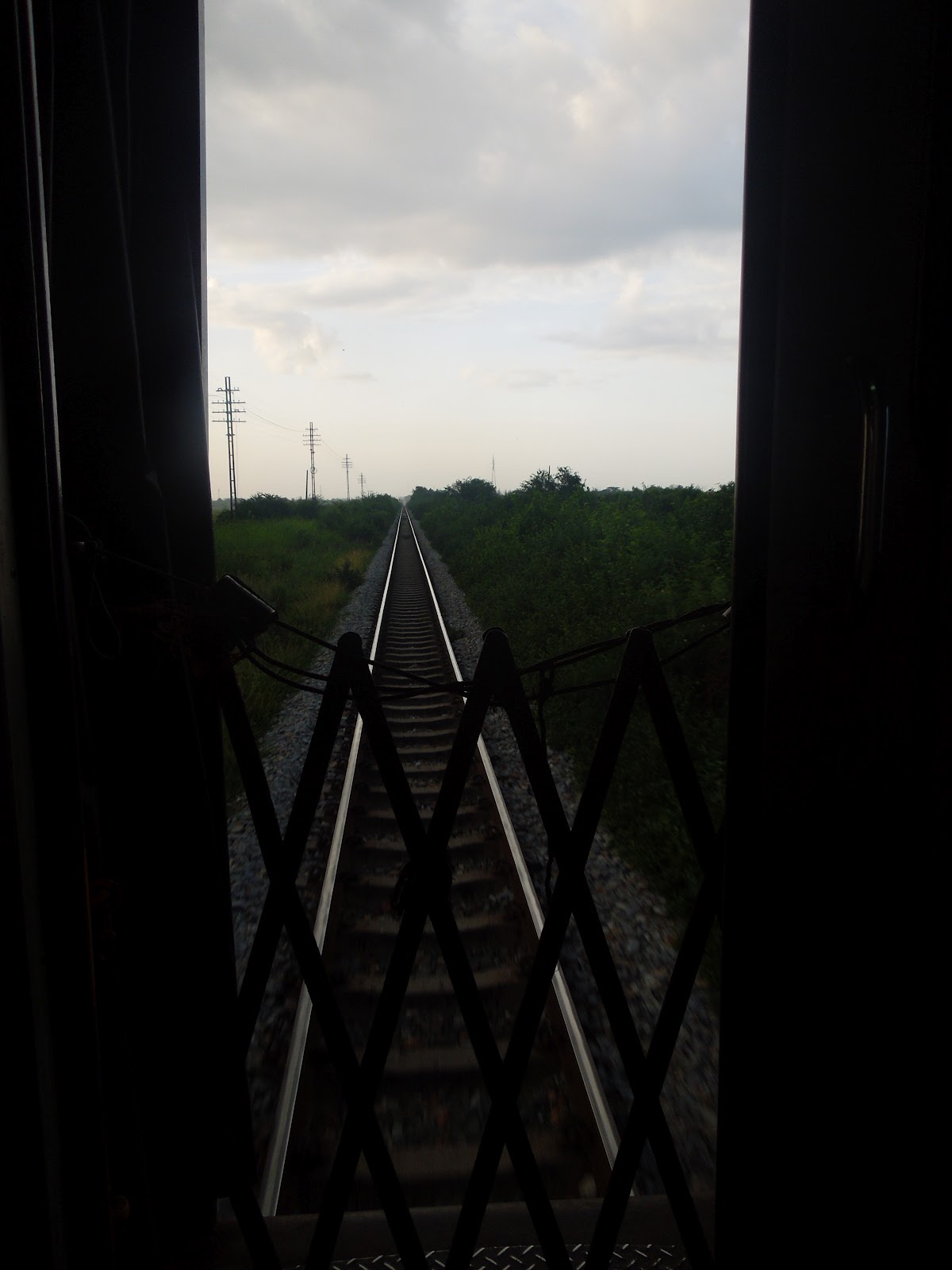
We passed little stations without stopping; at each one, a man in starchy uniform dropped his flag as we passed and returned to his room. At most, the minute we passed, people walked onto the tracks, carrying produce or children, or in one case, a great big weapon, for who knows what use. Surely there's nothing in the scrub or the rice padi that would hold up to a metre-and-a-half metal-and-wood hatchet?


The further we got from Bangkok, the smaller the stations became, until we passed Ban Trok Khae, which was the first of many train stations that are simply tiny brick shelters with a sign - more like a run-down bus stop than anything else.
From a side door I watched the gathering sunset pick out golden stupas from the landscape, and cranes floating over waterways choked with lilies and lotus flowers. We passed a temple complex on a hill, lit up in the dusk by powerful lights, white and gold like an overwrought wedding cake. Thai people are certainly not the shy, retiring type.
From a side door I watched the gathering sunset pick out golden stupas from the landscape, and cranes floating over waterways choked with lilies and lotus flowers. We passed a temple complex on a hill, lit up in the dusk by powerful lights, white and gold like an overwrought wedding cake. Thai people are certainly not the shy, retiring type.


. . .
In the morning, the scenery was more rural: rice padi fields and the occasional patch of bush and scrub. The karsts rose up in the distance again; it all felt quite familiar from the first trip through.
On our way to Hat Yai (around the time that my ticket said we should be arriving into Sungai Kolok), the attendant was changing seats into beds and gathering in blankets and pillows, when he started calling out in Thai, "something something something Hat Yai something." I looked about and everyone was nodding their acknowledgment, but thought, well, he's seen all us foreigners down this end, I'm sure if it's important, he'll come and try to let us know through sign language or something.
Hahaha. No, really.
Actually, I'm being a bit unfair here. He did come and check up on us. Approximately ten minutes before we reached Hat Yai, he came and looked at us worriedly for a bit. Then a neighbour took pity and translated for us: because there was no aircon or water in this carriage, we had to disembark in Hat Yai and wait for another train to come to bear us onwards to Sungai Kolok. When would this train come? Not sure, but we would get to Malaysia at about 4pm. No, 3pm. Well, maybe 4pm.
My friend and I looked at the other two foreigners in dismay - reaching Malaysia at 4 would mean missing the last ferry to the Perhentian Islands unless we were extremely lucky with transport. We asked the man if we couldn't stay on this train. Our translator explained there weren't any seats, but that he would try to find us one. We said, "We'll stand! Just please don't make us wait for another train!"
When we reached Hat Yai, the attendant came and took us and our bags to the next carriage along. He told us to wait there, but when he was gone, we thought that we might be more comfortable and have less chance of being kicked off if we were in the restaurant car. So off we went, piling our bags under the tables and sitting by the open window chatting to the other foreigners (who were at the end of a 6-month overland journey from Switzerland, so plenty to talk about).

After about an hour, during which time we hadn't moved, the attendant arrived in the restaurant car and said we could come and sit down again, so off we went again, following him to... a new carriage where all our fellow passengers were sitting. Yes, they hadn't meant "Wait for a new train", but "Wait for a new carriage." We felt a bit silly, really, for not simply getting onto the platform and waiting with the rest of them - I guess this is how tourists get a name for being difficult.

Anyway, the train finally set off again, heading into southern Thailand. We sat in our air-conditioned seats happily munching on green mango with chilli salt bought from one of the carts at the station.
Out the window, the scenery was still padi fields and small villages, the occasional rubber plantation flitting by. Wildlife too - well, mostly birdlife, really, but I did see some golden orb spiders, their bulk making them visible even from the train. Bee-eaters and kingfishers were common, and twice I saw fish eagles.
The scenery didn't change much, but the train stations did. When we reached Yala, an enormously long station, there were armed guards on the platform, and soldiers boarded our train, walking up and down the carriages talking to people for the remainder of the trip.


Thereafter, the small stations were guarded by soldiers, and were bound by well-kept metal fences, razor wire trimming the top. This being Thailand, of course, the fences weren't official grey, but were painted in bright reds, oranges and yellows.

The people changed at Yala, too - there was more of a Malay feel; women were still riding scooters, but now they were wearing tudong, the Malay headscarf. By Wat Chang Ha, mosques had become as visible as temples. The military presence grew - young Thai men in black vests and big boots, casually sporting rifles - they were set apart from locals by their paler skin, the locals being farmers and labourers.

Finally, finally, we came to Sungai Kolok, where we crossed the tracks (and by the way, I am all in favour of this method of crossing through a station - no lifts, elevators, stairs, tunnels or nasty smells in dark corners...) to the carpark to take a taxi to the border crossing, a few hundred metres away. There we left Thailand, and crossed a 50-metre No Man's Land, which spanned a small river - which, incidentally, was being crossed without any restrictions by the villagers who lived on either side :)

On the other side of the bridge, we returned to Malaysian soil.Actually, I'm being a bit unfair here. He did come and check up on us. Approximately ten minutes before we reached Hat Yai, he came and looked at us worriedly for a bit. Then a neighbour took pity and translated for us: because there was no aircon or water in this carriage, we had to disembark in Hat Yai and wait for another train to come to bear us onwards to Sungai Kolok. When would this train come? Not sure, but we would get to Malaysia at about 4pm. No, 3pm. Well, maybe 4pm.
My friend and I looked at the other two foreigners in dismay - reaching Malaysia at 4 would mean missing the last ferry to the Perhentian Islands unless we were extremely lucky with transport. We asked the man if we couldn't stay on this train. Our translator explained there weren't any seats, but that he would try to find us one. We said, "We'll stand! Just please don't make us wait for another train!"
When we reached Hat Yai, the attendant came and took us and our bags to the next carriage along. He told us to wait there, but when he was gone, we thought that we might be more comfortable and have less chance of being kicked off if we were in the restaurant car. So off we went, piling our bags under the tables and sitting by the open window chatting to the other foreigners (who were at the end of a 6-month overland journey from Switzerland, so plenty to talk about).

After about an hour, during which time we hadn't moved, the attendant arrived in the restaurant car and said we could come and sit down again, so off we went again, following him to... a new carriage where all our fellow passengers were sitting. Yes, they hadn't meant "Wait for a new train", but "Wait for a new carriage." We felt a bit silly, really, for not simply getting onto the platform and waiting with the rest of them - I guess this is how tourists get a name for being difficult.

Anyway, the train finally set off again, heading into southern Thailand. We sat in our air-conditioned seats happily munching on green mango with chilli salt bought from one of the carts at the station.
Out the window, the scenery was still padi fields and small villages, the occasional rubber plantation flitting by. Wildlife too - well, mostly birdlife, really, but I did see some golden orb spiders, their bulk making them visible even from the train. Bee-eaters and kingfishers were common, and twice I saw fish eagles.
The scenery didn't change much, but the train stations did. When we reached Yala, an enormously long station, there were armed guards on the platform, and soldiers boarded our train, walking up and down the carriages talking to people for the remainder of the trip.


Thereafter, the small stations were guarded by soldiers, and were bound by well-kept metal fences, razor wire trimming the top. This being Thailand, of course, the fences weren't official grey, but were painted in bright reds, oranges and yellows.

The people changed at Yala, too - there was more of a Malay feel; women were still riding scooters, but now they were wearing tudong, the Malay headscarf. By Wat Chang Ha, mosques had become as visible as temples. The military presence grew - young Thai men in black vests and big boots, casually sporting rifles - they were set apart from locals by their paler skin, the locals being farmers and labourers.

Finally, finally, we came to Sungai Kolok, where we crossed the tracks (and by the way, I am all in favour of this method of crossing through a station - no lifts, elevators, stairs, tunnels or nasty smells in dark corners...) to the carpark to take a taxi to the border crossing, a few hundred metres away. There we left Thailand, and crossed a 50-metre No Man's Land, which spanned a small river - which, incidentally, was being crossed without any restrictions by the villagers who lived on either side :)