Showing posts with label Cascais. Show all posts

Monday, March 21, 2011

Taking one's time

Life in Portugal mostly moves at a pretty slow pace. This morning I left the school I work at, and just across the road I waved at the lady who works in the papelaria nearby. She was chatting to a friend. I walked up to the supermarket, bought the things I needed to buy, stopped for a coffee. When I got back to the school 25 minutes later, she was still chatting to her friend, laughing away in the unseasonal sunlight, not a care in the world about her untended shop, because she knew if a customer walked in, the shopkeeper next door would hear the bell and give her a shout.

The roadworks are not designed to be completed quickly either. Many of the main roads in Cascais are cobbled, which means that when they need to be repaired or replaced, it involves an enormous pile of granite rock, and about five men with tiny hammers, who chip each cobblestone into the perfect size, then place it with artistic care. Then a man comes along with a giant piece of iron to hammer the stones into the ground. Then a seventh man fills the gaps with sand, and an eighth carefully sweeps up any excess. By the time the eighth man has come along, the first team has moved perhaps a couple of metres down the road. It's painfully slow, albeit with a very pretty result. The pavements are the same, but for the rather eye-watering black-and-white wave effect in Cascais, the process has to involve a big wooden template as well.

All part of the joy of living in southern Europe!

Monday, October 25, 2010

Visiting

I want you to turn away from the computer and go to your childhood bookshelf. The one stuffed with all the big fairybooks and broken-spined Grimm's collections. Are you there? Find a fairy tale and open it to the picture of the castle. The one with the princess in the turret and the ogre in the dungeon. Pretty isn't it?

That's where I was on Friday.

On Thursday my Dad arrived from England, which was very exciting, and even more so when my big meeting-up plan worked like a dream, and I didn't have to run around Lisbon desperately looking for him.

The next morning I looked out of my window at the Serra de Sintra and, not seeing any clouds, hustled down to Dad's hotel and onto a bus bound for Sintra Village. Although I can see it from my window, it's still a 40 minute bus ride from Cascais. Perched high in a forested national park, Sintra used to be the big town, and Cascais the fishing village. These days Sintra is the preserve of the rich and famous and daytrippers from Lisbon, and when I say these days, I'm talking about right back to Lord Byron's time; in fact, Byron called it his Glorious Eden and used it in his poem Childe Harold's Pilgrimage, while Hans Christian Andersen merely considered it the most beautiful place in Portugal. Several English notables ended up here, some for more noble reasons than others, and some of them made their marks in beautiful palaces and landscaped English gardens.

We rode the bus through suburbs and villages, climbing the landscape, until the castle I can see from my bedroom window as a grey sliver in the distance was more looming than slivering, then we got off. Unfortunately a couple of stops early, so we had to walk through the lower town for a short bit, but we fortified ourselves with a Portuguese brunch - coffee and pasteis de nata.


Heading onwards past deep valleys and tiny roadside shrines, we turned a corner and were suddenly in Sintra Vila proper, the National Palace before us, chestnut sellers on the corner. We equipped ourselves with a map and a paper bag of roasted chestnuts, and sat in a deserted corner, a treed courtyard with a bench overlooking the valley. We decided to see the castle, and we decided to walk up to it - I swear Dad had all the information at his disposal when he decided that!

It was a hard work, but we took it slowly. It wound up a steep mountainside for 700m, first through tiny houses (one was lived in by Hans Christian Andersen once) and churches, then through forest. The forest floor was dotted with great big slabs of rock which seemed unnaturally shaped and placed. A couple had definitely been hollowed out a bit - perhaps to supply a suitably uncomfortable place for a hermit to live out his life. Soon we started seeing more definite signs of life with thick defence walls and a ruined church.


The path became wider and more defined.


I climbed an interesting little tower to look down on the ruin, and only realised after scrambling down the narrow steps again that there was a skull-and-bones on the base - it was an ossuary for the bones from the church's crypt.


Finally we reached the main wall of the castle. The Moors conquered Iberia in the 8th century, and their final defeat in Portugal by Christian Portuguese in 1249 coincided with the establishment of Portugal as an independent nation. In Southern Portugal, they left behind some beautiful architecture and buildings, and some important names - Lisbon (Al-Ushbuna), Coimbra (Kulimriyya), Beja (Baja - where I lived as a student), the Algarve (al-Gharb) and the beautiful area we're now exploring - Sintra. The Moorish influence continued long after the last were expelled from Portugal and Spain in the centuries following their defeat. Portuguese people took up their paintbrushes and created some of the most beautiful pieces of pottery I've ever seen, with intricate patterns and convoluted stories. The Moorish Fountain is an early 20th century example in Sintra.


This is no pretty but fundamentally pointless folly, though - it remains a water source for local people to this day. We passed another fountain further up the hill, also built above a natural spring, where groups of older people were cheerfully ignoring the municipal sign restricting them to 2 litres a day, filling five or ten 5-litre bottles each, and loading them back onto their waiting bakkies...

Anyway, as I was saying: we'd just reached the top of the hill, where the Moorish castle sits like a natural eruption of pale stone. Less menacing than it perhaps would have been were the hill still deforested to the base, as I'm sure it would have been once. The forest has taken back its territory, and is thick even inside the walls - fairly useless if you wanted to see your enemies coming from far off! The fort - for that's really what it is - looks remarkably well-preserved for something built more than a thousand years ago, and which has been through a number of wars and nation-shattering earthquakes. And this is because it's not well-preserved, but rather well-renovated. Much of the lower walls and floors, and the amazing cistern have survived from the first occupants, though. Even the outdoor granaries are still there - despite having been converted to rubbish tips by the subsequent Christian occupants.


The view from the crenellated walls is astounding - villages on the coast, half a day's hard ride for 8th century warriors, are clearly visible. Sintra Village is just beneath - although if you bear in mind that we actually walked up to the Village, and only then up to the Castle, I'm pretty sure you're bloody impressed with us right now. If you're not, you should be.

Dotted throughout the forest were dozens of sprawling mansions, every one of them sprouting turrets and lace like a set designer had just learned the Grimm Brothers were coming to see the play tonight and were expecting perfection, thank you very much.


From one of the towers, the fanciful palace on the next hill is clear in its pink and yellow glory - Pena Palace, a 19th century pure embodiment of romanticism built over the ruins of a medieval monastery.

Sadly, after all our effort, we didn't feel up to battling the tourists for a closer glimpse, and when we left, it was straight onto a bus, which teetered its way down the hills to the bus station. And when I say teetered, I actually mean "perilously crashed" - Dad thought it might be a source of pride amongst the bus drivers as to who terrifies more tourists on each shift... From there we caught another bus back to Cascais, along the beautiful western coast.

Bedtime arrived early that night.


Saturday, September 25, 2010

Living

Nice thing about living in a small town: you get to know people. Not just my local cafe owner, but also the guy who wanders about smiling at everyone, his Tourettes manifesting itself in loud moans and groans and the occasional naughty word. Or the ancient fisherman with no front teeth who can't resist babies but never begs from their mothers (only from poor English teachers.) Or the tall dreadlocked Nigerian who wears a different traditional outfit every day and sells real Ray-Bans for €5. Bargain.

Cascais is a tourist town and has been since King Luís II first saw its crescent beaches in 1870 and decided it would be just fine for his annual summer vacation. But its native population (just 35,000) keeps a tight hold on its daily life - the fishermen still weave their nets on a secretive, rocky shore, the housewives still march about the streets chattering as loudly as they can, and the cafe air is still more full of Portuguese than English.

Long may it last.

Sunday, September 19, 2010

Walking

Thought I'd take you on a walk today. This is the walk I take whenever I go into town. Hah - yeah, right! It's actually the route my bus into town takes, because who walks when there's a bus, right? But it is the walk I sometimes take when the weather's not too hot, as it's the quickest way to town, and the most beautiful.

First we're going to walk down the road from my flat towards the sea. This area used to be a part of the protected Sintra green belt. Then, because developers don't like to see a nice bit of land wasted, some fires mysteriously burnt all the indigenous flora, and the land was sold to be turned into hotels. It's a common story in Portugal - in this dry country, it's often easier to burn your rival's olive grove than to compete with his business. When I studied in Coimbra, there'd just been a fire that could be seen from space - the firemen (who are volunteers in Portugal) had given up on fighting it, and had just concentrated on saving the houses on the edge of Coimbra, and so everything beyond was a blackened desert.

But pass the hotels, and the most amazing view opens up to you.


Not the roundabout, obviously, but the sea beyond. At this point, the coast has risen from the beaches of Estoril to become crumbling cliffs and jagged caves, and it continues to rise until it reaches Cabo de Roca, the westernmost point of Europe, a 20-minute drive from here. We turn left towards town.


Lined on one side by blue-green sea, black rocks and the dry, indigenous vegetation, the other side of the road is where exiled royalty came to hang out during the European revolutions and post-WWII. The last Italian king spent his 37-year exile in one of the grand palaces hidden behind high walls, and the Brits are represented by Princess Di, who, like Rei Umberto of Italy, had a road named after her. Following the path towards town takes us into a shallow dip, where walkers are shielded from the traffic by trees. The sound suddenly drops away, as if you'd stuffed your ears with cotton wool, and all that can be heard is the boats on the water if the wind is right, or the plop of a fisherman's line as he casts off from the rocks beneath.


A few steps down the road, the silence is forgotten as Boca do Inferno, the Mouth of Hell, thunders into view. A deep chasm in the cliff, where the sea froths its way through a narrow opening, this is partly famous for being the site of an English occultist magician's faked death in 1930. Aleister Crowley was a rather unpleasant man, and his stay in Portugal after being kicked out of Mussolini's Italy is not widely celebrated by the Catholic-minded Portuguese. His "suicide" was assisted by one of Portugal's best-known poets, Fernando Pessoa, and Boca do Inferno became a bit of a pilgrimage spot for all of a fortnight, before Crowley rocked up again in Berlin.


The day I took these photos the Boca was tame, although still noisy, echoing off the rocks; in the fiery build-up to storms, the plumes of spray can be seen from the town centre.

Onwards from the Boca. Just before a narrow bridge, on the right, is an old manor house, Casa de Santa Maria, a beautiful ramble of shuttered windows and tiny towers, overlooking the marina. It neighbours a lighthouse, typically Portuguese in its blue and white tiles.

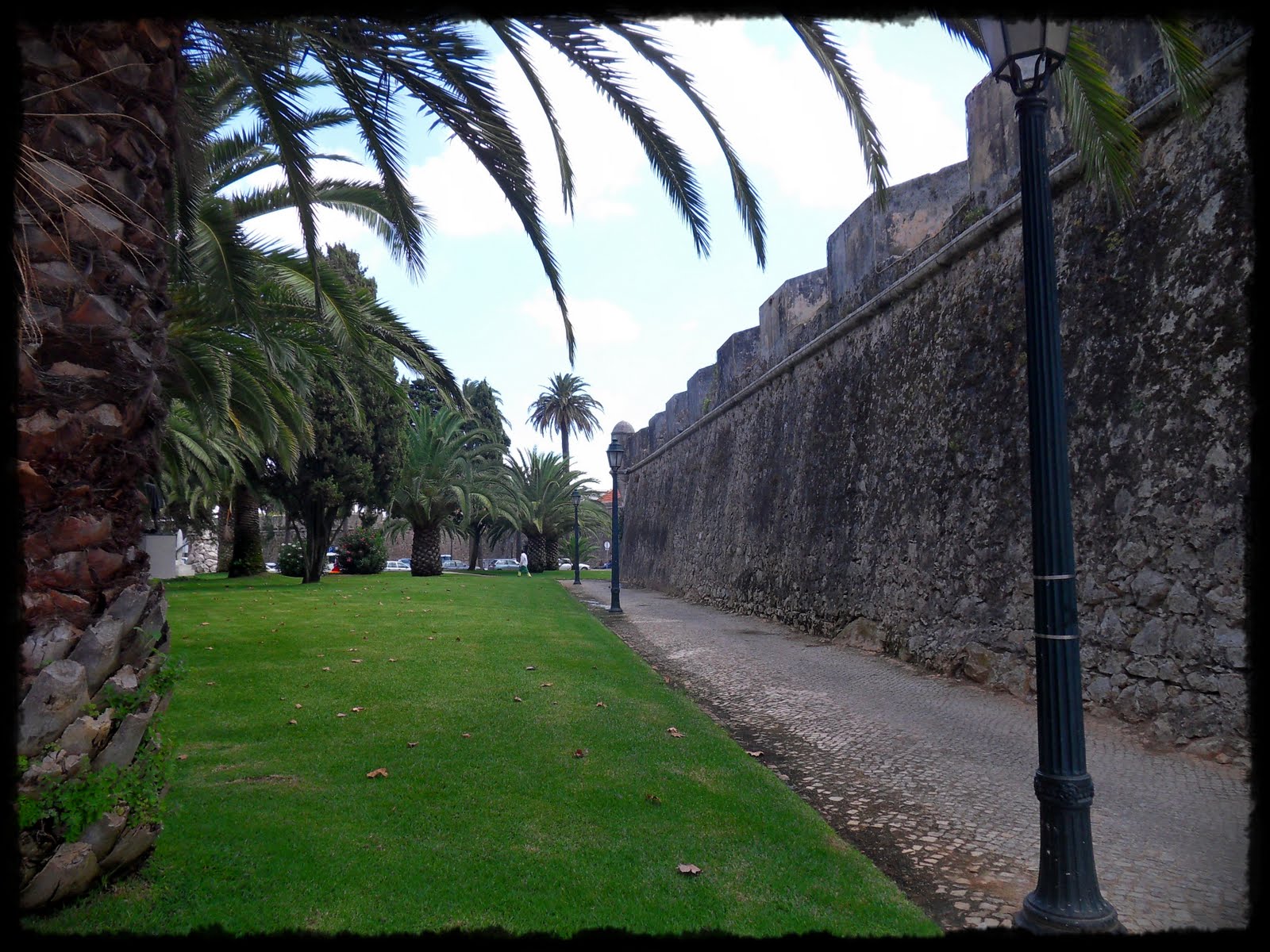
From Santa Maria, we cross the bridge to the marina and the castle. From the road, all that's visible over the fortified walls is a couple of cranes and some mysterious iron rods - something is being built or renovated or destroyed inside. Although the castle is owned by the council, it's not often open to the public. A friend tells me that sometimes they use it for classical concerts in the summer, but she's never gone; I'm definitely putting it on my list of things to do when they next plan one.


As we turn round the corner of the sprawling castle, the Baia opens up before us. Little brightly-painted fishing boats bob like apples, contrasting with a few sleek and enormous yachts, anchored just off a small curve of beach.


The fishermen store their equipment on a ledge below the promenade, watched over by a statue known as the Jolly King - a bronze statue of King Carlos the Diplomat, the last "real" king of Portugal, who loved the sea and spent many summers in Cascais. He's caught in the act of gazing over the Baia from a ship deck, telescope in hand.


Turning left at the Jolly King, the promenade drops down to sea level, a palm-lined road popular on weekends, when there's often a festival and Santini's, the venerable purveyors of ice cream to royalty for decades, has a stall by the mermaid statue (which you can just see behind the palm tree).


The road slips down to meet what would perhaps be called the Town Square, were it not so tiny; it contains the Town Hall, decorated with tiled portraits of the saints Pedro and Paulo.


We're two minutes from my school here, and so this is where we'll stop, on the bench where I often sit and have lunch or an ice cream, scoffing at the bright red tourists and envying the browned locals, keeping an eye on the fishermen's boats for them, until they come in the late afternoon with their nets and traps.

It's a hard life...


Wednesday, September 8, 2010

Paddling

So I feel a little like I've just hit the ground running. And the ground didn't even slow down with the impact. 10 hours in school on Monday for 2.5 hours of teaching, 11 hours on Tuesday, and I still ended up taking work home with me to plan for my classes on Wednesday. Friday was technically my day off - and that "technically" is placed there strategically so that you may know that "day off" is a theoretical term.

I have some lovely classes - two tiny 5-year-olds who babble at me in Portuguese about everything except the flashcard I'm holding up for them; three 8-year-olds who taught me how to say "maça" because I made it very clear that I didn't know what an apple was really called; a class of retired men who lived through the colonial wars (and the Portuguese colonial wars were devastating) and a revolution, but still listen politely to my thoughts on living in their country, and invite me out for coffee.

There's been a lot of coffee in my life. I need it. Really. There's a great, very simple cafe around the corner from the school where the waiter doesn't patiently listen to my painful Portuguese and then reply in English, but patiently listens to my Portuguese and then pretends he knows what I ordered. Usually he gets it right, but I think he's just got my favourites memorised.


I'm settling into my new place, which is a little flat (in the picture below it's in the middle of the big block, second from top, with an open balcony) just north of the city centre.


I share with Maria, who's a little younger than me but is doing very grown-up things that involve research labs and medical degrees and white coats, and Luisa, who is crazy. In her words. She's pretty awesome, lived in Angola before independence, came home, divorced her husband in Catholic Portugal, and lived to tell the tale sitting beside her well-adjusted daughter in a lounge littered with African statues and paintings. I also share the flat with Nala, who's crazier than Luisa, but can't natter away about it while chain-smoking, because she's a cat.


Once I get the hang of not spending 5 hours planning for an 80-minute class, I promise to tell you stories about Cascais. Just you wait till I get me a life...

Friday, September 3, 2010

Persevering

Well, I got the social security number. It near about killed me. I got talking to a guy from Angola while sitting outside waiting for my turn (I got there an hour before it opened, and was 48th in the third queue...) and he was very kind; him being the number before me, we went into the office together and he helped to translate when my "Slowly please!" didn't work on the official. It took another two trips to Finanças and one to my new Portuguese bank, but by 4pm I was through. I'm now the proud owner of 8 official pieces of paper which state my right to work here, which amazes me, as every EU citizen has the right to work in any EU nation anyway. But.

At least while waiting for my number to be called, I had time to wander around the area. It's quite amazing. Cascais itself is a popular seaside holiday for tourists from all over Europe; down by the seafront, the shops all sell postcards and green-and-red teatowels, and if you speak to someone in Portuguese, they answer in English. But here, just two (steep) blocks from the centre, it's quiet and traditional, and the voices in the streets are all clearly swallowing their words. Properly Lusophone.


The next day I started a three-day induction at my new school. All the teachers are undertaking some workshops run by the British Council, which is great, and very interesting. The other teachers (1 new, 3 veteran) are very friendly, and, astoundingly, all have British and Irish accents - I'm the only colonial there. The school is in a prime position near the fishermen's marina and in the very centre of town. It's the white building on the right:


Inside, there are 7 brightly-painted classrooms off a central reception.


I start actual classes on Monday with a group of 5 year olds - as terrifying as they are cute, believe me. I've never taught kids as young, but my director is great and will be walking me through it on Monday morning. I gather from the lesson plans that should you be wandering down the road that afternoon, and happen to pause by my open window, you will be able to hear me doing something I never do in front of any sane adult: singing!

Friday, August 27, 2010

Arriving

Having newly arrived in Portugal, I spent my first night at a celebrated hostel in Lisboa - one of the best in the world, according to certain sources. Amazingly spacious and beautifully done up, and clearly having cost a great deal of money right in the centre of Lisboa, I have to say I felt more at home in my sister's sweet hostel in London, where the staff's personality is there to see on every wall and in every room. The next day I was off on the railway line down the coast to São Pedro do Estoril, a small village just 20 minutes from Lisboa. I'd found a room there online, but, regardless of the enormous pool in the garden, the steep walk to the train station, from where I needed to catch a train to Cascais where I'll be working, was enough to convince me on the first day that unless I wanted to scare small children in the streets with my scarlet complexion and wheezing, I needed to find somewhere to stay in Cascais itself. Unfortunately, Cascais being as popular with wealthy Lisboans as it is with retired Europeans, rent costs twice as much in the centre as anywhere else in the area.

Sometimes life astounds me with its inventive coincidences. On Tuesday I went into Cascais to get some paperwork done. First stop was the Town Hall to get my Certificate of Residency, which I needed to apply for my Social Security Number. Unfortunately, you can't pay for the Certificate without the SS number - a rather strange governmental catch-22. Luckily, the lovely lady behind the computer, while quite underwhelmed by my attempts at Portuguese and urging me to take classes soon, offered to use her own Number for the receipt. First hurdle cleared. Town Hall having taken less time than expected, I decided to go to the Finanças office and walked all the way there up a steep hill, only to remember, at the door, that I didn't have my employment contract, which I'd been told I would need. So back into town I went, searching for an internet cafe in the cobbled streets of the old town, but not a single one was to be found. There's another Finanças office in another nearby town which I'd heard could be faster than the larger Cascais one, so I was about to give up for the day in Cascais when, outside the train station, I noticed a big official looking building advertising its Internet Space. I went inside to find a completely free governmental initiative where I could print my contract. Gotta love Europe. On my way out, I paused to look at an advert for yoga classes on the community noticeboard, and right next to it was a handwritten note offering a room to rent. Not being entirely happy in my current place, I took down the phone number. Back at Finanças, I glanced down the street to see an internet cafe almost next door... The dire warnings of two-hour waits evaporated in the face of a wait barely long enough for me to catch my breath. And guess what? They never even asked for my contract. Typical. That evening, my telephone skills utterly deserting me in my time of need, I texted the woman with the flat and set up an appointment to see it the next day. It's ideal. Cheap, close to town and the school, near a gym and a park, in a spotless apartment with a Portuguese woman, her fascinating English-professor mum and a tiny cat. Where would I be if my Finanças information had been right?!

I'm settled into the room now, and have been to see the director of my school; I have a bank account, a tax contribution number, a certificate of residency, a written income confirmation and a local resident card. Feeling proud. Still to get: my social security number, and a health card, which relies on getting the former. I anticipate the social security application with trepidation - I need to be there by 7am to get into the queue to get a number to get into a queue to see an officer, and then I don't know if he'll see me without having the forms, which are unobtainable without seeing the officer... Portuguese bureaucracy nearly rivals Zimbabwe's! But the sun shines, the sea beckons, and the cafe round the corner from Social Security serves amazing pasteis de nata; I'm already thinking of signing up for another year!