Early on Sunday morning I packed my bags and left Rivertime for the airport. On the 40-minute drive, Joy told me of his great happiness at entering the army in two months' time. So very different to South Korea where most men would do anything to get out of serving... With Lunar New Year and Valentine's Day falling on the same weekend this year, the streets were awash with red - lanterns for the new year, teddies and roses for the lovers, everything sold together from tiny stalls on the roadside. There was one particularly blessed woman somewhere in Vientiane, whose boyfriend sat in a tuk-tuk in front of our car, red and white balloons billowing out the back and completely obscuring the door. Even the dress code matched the event, with a red t-shirt or dress atop every scooter. I was rather glad to leave the American-style commercialism behind at the airport gates!
I quickly cleared check-in and went through to the waiting lounge, a grid of hard plastic chairs looking out to the runway where a plane was waiting. Not, surely, my plane, for I was flying the national airline on their busiest route, and this was a teensy tiny propellor plane.

With a lovely flower on its tail, yes, but still teensy, nonetheless. I sat and waited, but no other flights were announced and no other plane showed up, and the pilots walked through, pushing the unlocked doors open to the tarmac, and then a sweet lady in her silk uniform told us we could now board. So we all did, walking across the tarmac to get to the 5-step ladder. Which of course I have done before at other small airports. I have, however, never had to duck to get in through an aeroplane door... My window seat was right in the middle, right under the wing, and next to the wheels.
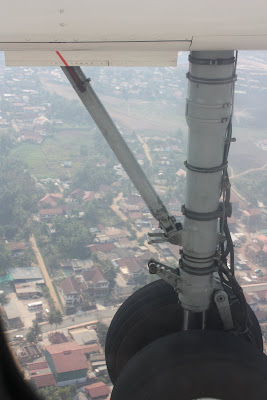
I started to understand why other travellers were wary of flying Lao Airlines, but in the end it was a perfectly pleasant, very short flight over valleys and mountains and bright red dirt roads. As we descended into Luang Prabang, the Mekong stretched and yawned beneath us, curling around the little town, gold temples reflecting the morning sunlight into my eyes. Luang Prabang used to be a distant colonial outpost for French officials who, for one reason or another, never wanted to go home again. In my 40-minute flight I leapt over a month's travelling. It used to take longer to get from Bangkok to Luang Prabang than to go from Bangkok to France by ship! Perhaps as a result of this unimaginable distance, the officials who settled here eventually turned it into a beautiful village in the French style, with shuttered two-storey cottages lining a narrow street, and a boulevard running above the Mekong with space for a cafe table or two.

The town mostly fills the peninsular space between the Mekong and the Nam Khan, a river that joins the Mekong here. On the 15-minute tuk-tuk ride to my hostel, I started to see the chaotic Asian traffic I missed in the Vientiane countryside. There are scooters and tuk-tuks everywhere, although it's still far from the stereotypical Vietnamese streetscene. I was barely at the hostel long enough to dump my bag on my bed, and then I was off to the main street, Th Sisavangvong, named after the king at the time of independence from France. Lovely.

With a lovely flower on its tail, yes, but still teensy, nonetheless. I sat and waited, but no other flights were announced and no other plane showed up, and the pilots walked through, pushing the unlocked doors open to the tarmac, and then a sweet lady in her silk uniform told us we could now board. So we all did, walking across the tarmac to get to the 5-step ladder. Which of course I have done before at other small airports. I have, however, never had to duck to get in through an aeroplane door... My window seat was right in the middle, right under the wing, and next to the wheels.

I started to understand why other travellers were wary of flying Lao Airlines, but in the end it was a perfectly pleasant, very short flight over valleys and mountains and bright red dirt roads. As we descended into Luang Prabang, the Mekong stretched and yawned beneath us, curling around the little town, gold temples reflecting the morning sunlight into my eyes. Luang Prabang used to be a distant colonial outpost for French officials who, for one reason or another, never wanted to go home again. In my 40-minute flight I leapt over a month's travelling. It used to take longer to get from Bangkok to Luang Prabang than to go from Bangkok to France by ship! Perhaps as a result of this unimaginable distance, the officials who settled here eventually turned it into a beautiful village in the French style, with shuttered two-storey cottages lining a narrow street, and a boulevard running above the Mekong with space for a cafe table or two.

The town mostly fills the peninsular space between the Mekong and the Nam Khan, a river that joins the Mekong here. On the 15-minute tuk-tuk ride to my hostel, I started to see the chaotic Asian traffic I missed in the Vientiane countryside. There are scooters and tuk-tuks everywhere, although it's still far from the stereotypical Vietnamese streetscene. I was barely at the hostel long enough to dump my bag on my bed, and then I was off to the main street, Th Sisavangvong, named after the king at the time of independence from France. Lovely.
Of course, it has the usual ebullience of Asia, but the allure of the town is in the bougainvillea creeping over the carved wooden balconies, and the open-fronted cafes. Asia shows her motherhood in the street food sellers - I buy a coconut dumpling straight away from a man who says he has 7 children to feed, although at least in the drawing on his cart they all have very smiley faces - the friendliness of the people - the dumpling seller chats to me for 5 minutes then makes me another one because he sees the sticky smile on my face, then tries to refuse to let me pay my 10p - the brightly coloured tuk-tuks everywhere - often with movie scenes painted on the sides.

Of course, because this is the 21st century, all the houses and cottages are now massage spas and restaurants, tour agencies and money changers. This is a town where people feel comfortable leaning over from their table to contribute to your private conversation, as if because we're all tourists we're the same, and should help each other out with tips and warning tales. Every Lao person is seemingly in the tourist industry, from men guiding the tours, to women giving foot massages and selling silks, to the children selling trinkets when they're not at school. At least the kids do go to school - when I tried to fob off one persistent ten-year-old with "maybe tomorrow", she retorted "Tomorrow school, every child learning learning. You buy now."
I did "buy now" in the end...
I retreated to my room for a late afternoon siesta but I'm back at 5:30 for the night market, a sea of silk and silver that shuts down Th Sisavangvong.


I eat street food, which in this fairytale land means a vegetarian baguette and a fruit smoothie, and wander about talking to sellers and deciding what I would buy if I were a millionaire. I pass the boat pier where a rotund man sporting an improbably moustache suggests I might like to take a boat to the other side of the river, "with your boyfriend" he says. I tell him I have no boyfriend. He and a nearby tuk-tuk driver laugh and shake their heads at the shame of being an elderly spinster. "That pity," the boatman says, "but don't worry, for today, I can be boyfriend." I laugh with the two of them, politely decline, and move on.


I eat street food, which in this fairytale land means a vegetarian baguette and a fruit smoothie, and wander about talking to sellers and deciding what I would buy if I were a millionaire. I pass the boat pier where a rotund man sporting an improbably moustache suggests I might like to take a boat to the other side of the river, "with your boyfriend" he says. I tell him I have no boyfriend. He and a nearby tuk-tuk driver laugh and shake their heads at the shame of being an elderly spinster. "That pity," the boatman says, "but don't worry, for today, I can be boyfriend." I laugh with the two of them, politely decline, and move on.

On Monday I walked down to the Mekong, still bleary-eyed with sleep, which was interrupted repeatedly by the person in the dorm above mine shifting position in his (I presume) sleep. Not a well-soundproofed room - but then, it is almost eighty years old. I've booked a space on a boat down the river so I patiently wait on the benches at the ticket office (a glorified shed under some lovely old trees on the riverbank) until my ticket number is called.

I scramble down the steep steps and wobble my way onto a boat, where before the five other passengers can say hello, I nearly knock myself out on a low beam, adding a bump on the head to an infected scrape on a toe on my list of Laotian injuries. Not as impressive as the Balinese list yet, but it's early days... The boat is a traditional long boat. Low and narrow, both ends sit out of the water. It's steered from the front, though the engine sits towards the back, in front of a living space. Only six passengers are accommodated on each boat; the rest of the area is taken up by the family whose home this is. I could see that being awkward, but I'd luckily been assigned a lovely young couple, the wife nursing a cheerful baby boy, and it felt less like an intrusion than a homestay.


I scramble down the steep steps and wobble my way onto a boat, where before the five other passengers can say hello, I nearly knock myself out on a low beam, adding a bump on the head to an infected scrape on a toe on my list of Laotian injuries. Not as impressive as the Balinese list yet, but it's early days... The boat is a traditional long boat. Low and narrow, both ends sit out of the water. It's steered from the front, though the engine sits towards the back, in front of a living space. Only six passengers are accommodated on each boat; the rest of the area is taken up by the family whose home this is. I could see that being awkward, but I'd luckily been assigned a lovely young couple, the wife nursing a cheerful baby boy, and it felt less like an intrusion than a homestay.

At the other end of the two-hour journey were the Pak Ou caves: the lower one, Tham Ting, a gaping black cavity in the limestone cliff, reached by crude, whitewashed steps.

Our boat driver moored at the far end of a line of boats; we climbed over three other boats to reach a wide bamboo raft which acts as jetty and leads to the foot of the steps where a $2 entrance fee must be paid.

Our boat driver moored at the far end of a line of boats; we climbed over three other boats to reach a wide bamboo raft which acts as jetty and leads to the foot of the steps where a $2 entrance fee must be paid.
The cave had religious significance for the people living in the valley long before the Lao arrived here from China. The religion changed, the significance remained, and then Buddhism arrived. Inside, the cave rises from the mouth, creating a kind of amphitheatre in which we the visitors become the actors on a stage. The audience, silent, but each with their own unique expression, is thousands upon thousands of Buddha statues. They sit and watch, some in the meditation pose, or Calling for Rain. Some with their hands extended, open-palmed, exhorting listeners to Stop Arguing, a rare pose for a Buddha. A few lack heads or arms or bodies: these have been brought here and left, as if it were a Buddha graveyard for unwanted icons. Many, though, were crafted by royal sculptors for kings.


They sit on rocks and in cracks right up to the ceiling of the cave, gold, bronze, wooden and painted.

I venture up a path on the side of the mountain to the second, higher cave. All the way up there are ragged children who wave tiny, meticulously made bamboo cages. Inside tiny songbirds flutter their wings, waiting for Buddhists to buy them for a dollar and release them, thereby purchasing extra credit in the ladder of good karma. I wonder if you wouldn't gain just as much karma by not buying them, thereby discouraging their capture in the first place. I am taking a photo of the view over the river when a boy thrusts a cage at me and cries "photo!" So I take one, and show it to him. He smiles, but then babbles in Lao and another child translates: "He say, you take photo, you pay him. Only one dollar. You pay." Whoever told me Lao weren't as mercenary as their Asian neighbours had their tongue firmly in their cheek.

On the return journey, our boat pauses at Ban Xang Hai, a village famous for its lao-lao - rice whisky. We get off the boat onto a jetty, 500m of death-defying rickety bamboo poles crossing the exposed Mekong mud. In the village we're invited to try the lao-lao, which tastes like wine laced with vodka, and watch it being fermented, which is very exciting. Like watching grass grow. The pots remind me of the clay containers used for fermenting kimchi in Korea.
The boat trip itself is perhaps the most interesting aspect of an interesting day. There are fishermen in bamboo hats casting fine nets from their low boats, and women cultivating lettuce and cucumbers on the banks. Now and then a village passes into view, connected to the shore by ladders or sometimes mud steps, the grass-roofed huts poking out of thick vegetation.


During the Vietnam War, the US waged a "secret war" in Laos, training Hmong fighters for illegal skirmishes along the Vietnamese border. When the Vietnamese started importing arms along a trail that led through north-eastern Laos (the Ho Chi Minh Trail of legend), America carpet bombed the "neutral" country, increasing support locally for the communists, both Lao and Vietnamese. With the current wars in Iraq and Afghanistan, I can't help feeling the Americans will never learn their lesson. Floating peacefully down the river I watch the thick forest lining the banks and imagine how terrifying it must have been to have had to travel in the 1970s - with the CIA, the Viet Minh and the local communist army, the Pathet Lao all operating in the area, I can't imagine feeling less safe.


During the Vietnam War, the US waged a "secret war" in Laos, training Hmong fighters for illegal skirmishes along the Vietnamese border. When the Vietnamese started importing arms along a trail that led through north-eastern Laos (the Ho Chi Minh Trail of legend), America carpet bombed the "neutral" country, increasing support locally for the communists, both Lao and Vietnamese. With the current wars in Iraq and Afghanistan, I can't help feeling the Americans will never learn their lesson. Floating peacefully down the river I watch the thick forest lining the banks and imagine how terrifying it must have been to have had to travel in the 1970s - with the CIA, the Viet Minh and the local communist army, the Pathet Lao all operating in the area, I can't imagine feeling less safe.
That afternoon I spent wandering the peninsula and drinking thick Lao coffee at street stalls. In amongst the hundreds of tourists, ordinary Lao went about their business unobtrusively. I started to see beyond the play put on for tourists. Though I've generally found the people here to be far less friendly and open than down near Vientiane (too much contact with pushy Westerners perhaps?), once I start sitting and smiling at people, I can see their hospitality and willingness to talk resurface.
Everywhere I look, the saffron and yellow robes and shaved heads of the monks brighten the day. They wander the streets, their faded golden bags slung over their shoulders, talking to each other and buying fruit. The novices are as young as 7 or 8, taken to the temples by parents desperate to ensure them education and a daily meal (just one though - the monks eat only at lunchtime, I'm told). Sometimes a truck or tuk-tuk passes, filled to the brim with the orange robes.


