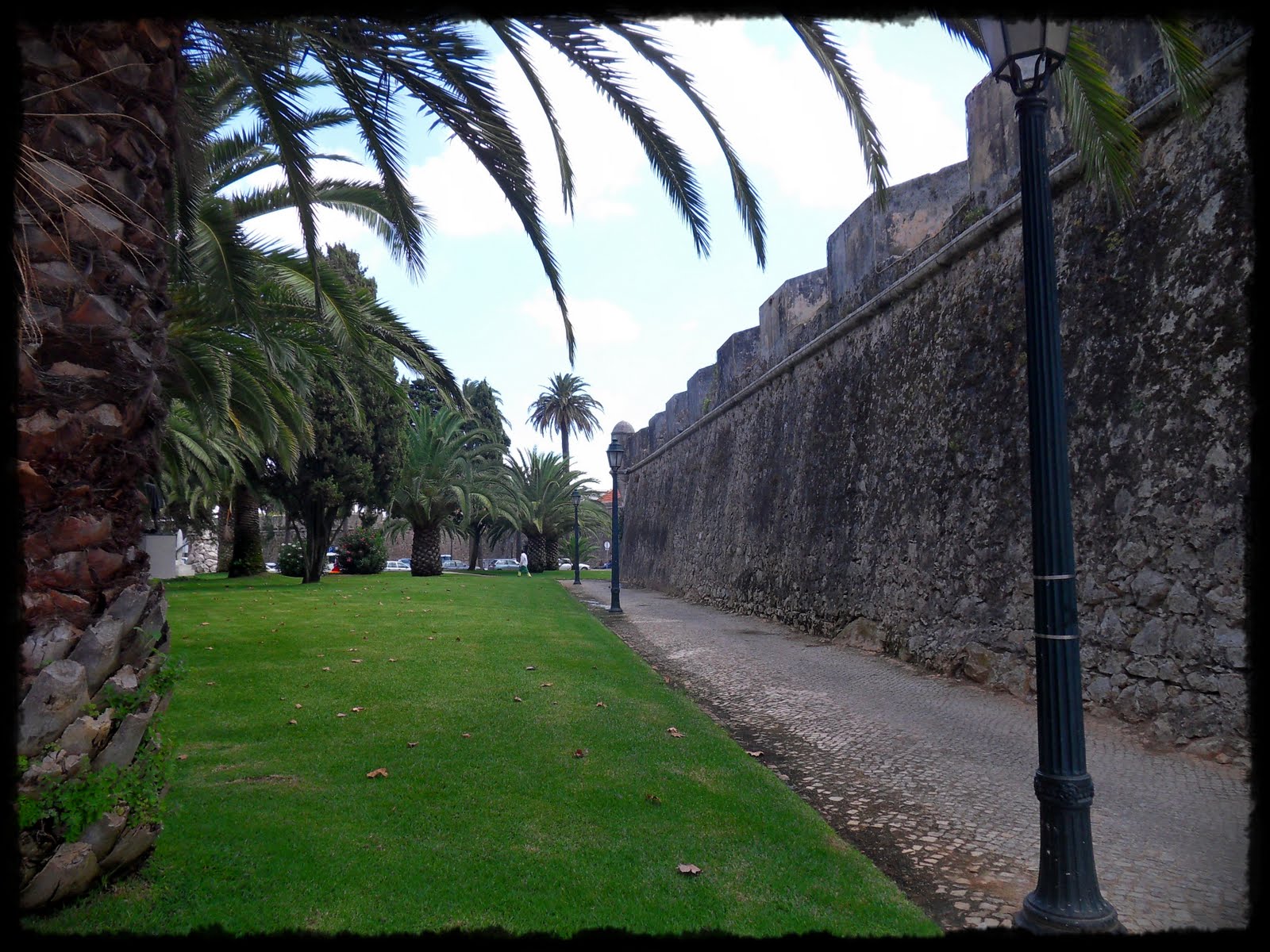
I want you to turn away from the computer and go to your childhood bookshelf. The one stuffed with all the big fairybooks and broken-spined Grimm's collections. Are you there? Find a fairy tale and open it to the picture of the castle. The one with the princess in the turret and the ogre in the dungeon. Pretty isn't it?
That's where I was on Friday.
On Thursday my Dad arrived from England, which was very exciting, and even more so when my big meeting-up plan worked like a dream, and I didn't have to run around Lisbon desperately looking for him.
The next morning I looked out of my window at the Serra de Sintra and, not seeing any clouds, hustled down to Dad's hotel and onto a bus bound for Sintra Village. Although I can see it from my window, it's still a 40 minute bus ride from Cascais. Perched high in a forested national park, Sintra used to be the big town, and Cascais the fishing village. These days Sintra is the preserve of the rich and famous and daytrippers from Lisbon, and when I say these days, I'm talking about right back to Lord Byron's time; in fact, Byron called it his Glorious Eden and used it in his poem Childe Harold's Pilgrimage, while Hans Christian Andersen merely considered it the most beautiful place in Portugal. Several English notables ended up here, some for more noble reasons than others, and some of them made their marks in beautiful palaces and landscaped English gardens.
We rode the bus through suburbs and villages, climbing the landscape, until the castle I can see from my bedroom window as a grey sliver in the distance was more looming than slivering, then we got off. Unfortunately a couple of stops early, so we had to walk through the lower town for a short bit, but we fortified ourselves with a Portuguese brunch - coffee and pasteis de nata.

Heading onwards past deep valleys and tiny roadside shrines, we turned a corner and were suddenly in Sintra Vila proper, the National Palace before us, chestnut sellers on the corner. We equipped ourselves with a map and a paper bag of roasted chestnuts, and sat in a deserted corner, a treed courtyard with a bench overlooking the valley. We decided to see the castle, and we decided to walk up to it - I swear Dad had all the information at his disposal when he decided that!

Heading onwards past deep valleys and tiny roadside shrines, we turned a corner and were suddenly in Sintra Vila proper, the National Palace before us, chestnut sellers on the corner. We equipped ourselves with a map and a paper bag of roasted chestnuts, and sat in a deserted corner, a treed courtyard with a bench overlooking the valley. We decided to see the castle, and we decided to walk up to it - I swear Dad had all the information at his disposal when he decided that!
It was a hard work, but we took it slowly. It wound up a steep mountainside for 700m, first through tiny houses (one was lived in by Hans Christian Andersen once) and churches, then through forest.  The forest floor was dotted with great big slabs of rock which seemed unnaturally shaped and placed. A couple had definitely been hollowed out a bit - perhaps to supply a suitably uncomfortable place for a hermit to live out his life. Soon we started seeing more definite signs of life with thick defence walls and a ruined church.

The path became wider and more defined.
 The forest floor was dotted with great big slabs of rock which seemed unnaturally shaped and placed. A couple had definitely been hollowed out a bit - perhaps to supply a suitably uncomfortable place for a hermit to live out his life. Soon we started seeing more definite signs of life with thick defence walls and a ruined church.
The path became wider and more defined.

I climbed an interesting little tower to look down on the ruin, and only realised after scrambling down the narrow steps again that there was a skull-and-bones on the base - it was an ossuary for the bones from the church's crypt.

Finally we reached the main wall of the castle. The Moors conquered Iberia in the 8th century, and their final defeat in Portugal by Christian Portuguese in 1249 coincided with the establishment of Portugal as an independent nation. In Southern Portugal, they left behind some beautiful architecture and buildings, and some important names - Lisbon (Al-Ushbuna), Coimbra (Kulimriyya), Beja (Baja - where I lived as a student), the Algarve (al-Gharb) and the beautiful area we're now exploring - Sintra. The Moorish influence continued long after the last were expelled from Portugal and Spain in the centuries following their defeat. Portuguese people took up their paintbrushes and created some of the most beautiful pieces of pottery I've ever seen, with intricate patterns and convoluted stories. The Moorish Fountain is an early 20th century example in Sintra.


This is no pretty but fundamentally pointless folly, though - it remains a water source for local people to this day. We passed another fountain further up the hill, also built above a natural spring, where groups of older people were cheerfully ignoring the municipal sign restricting them to 2 litres a day, filling five or ten 5-litre bottles each, and loading them back onto their waiting bakkies...
Anyway, as I was saying: we'd just reached the top of the hill, where the Moorish castle sits like a natural eruption of pale stone. Less menacing than it perhaps would have been were the hill still deforested to the base, as I'm sure it would have been once. The forest has taken back its territory, and is thick even inside the walls - fairly useless if you wanted to see your enemies coming from far off! The fort - for that's really what it is - looks remarkably well-preserved for something built more than a thousand years ago, and which has been through a number of wars and nation-shattering earthquakes. And this is because it's not well-preserved, but rather well-renovated. Much of the lower walls and floors, and the amazing cistern have survived from the first occupants, though. Even the outdoor granaries are still there - despite having been converted to rubbish tips by the subsequent Christian occupants.

The view from the crenellated walls is astounding - villages on the coast, half a day's hard ride for 8th century warriors, are clearly visible. Sintra Village is just beneath - although if you bear in mind that we actually walked up to the Village, and only then up to the Castle, I'm pretty sure you're bloody impressed with us right now. If you're not, you should be.
 Dotted throughout the forest were dozens of sprawling mansions, every one of them sprouting turrets and lace like a set designer had just learned the Grimm Brothers were coming to see the play tonight and were expecting perfection, thank you very much.

From one of the towers, the fanciful palace on the next hill is clear in its pink and yellow glory - Pena Palace, a 19th century pure embodiment of romanticism built over the ruins of a medieval monastery.
 Sadly, after all our effort, we didn't feel up to battling the tourists for a closer glimpse, and when we left, it was straight onto a bus, which teetered its way down the hills to the bus station. And when I say teetered, I actually mean "perilously crashed" - Dad thought it might be a source of pride amongst the bus drivers as to who terrifies more tourists on each shift... From there we caught another bus back to Cascais, along the beautiful western coast.
Bedtime arrived early that night.

Anyway, as I was saying: we'd just reached the top of the hill, where the Moorish castle sits like a natural eruption of pale stone. Less menacing than it perhaps would have been were the hill still deforested to the base, as I'm sure it would have been once. The forest has taken back its territory, and is thick even inside the walls - fairly useless if you wanted to see your enemies coming from far off! The fort - for that's really what it is - looks remarkably well-preserved for something built more than a thousand years ago, and which has been through a number of wars and nation-shattering earthquakes. And this is because it's not well-preserved, but rather well-renovated. Much of the lower walls and floors, and the amazing cistern have survived from the first occupants, though. Even the outdoor granaries are still there - despite having been converted to rubbish tips by the subsequent Christian occupants.

The view from the crenellated walls is astounding - villages on the coast, half a day's hard ride for 8th century warriors, are clearly visible. Sintra Village is just beneath - although if you bear in mind that we actually walked up to the Village, and only then up to the Castle, I'm pretty sure you're bloody impressed with us right now. If you're not, you should be.
 Dotted throughout the forest were dozens of sprawling mansions, every one of them sprouting turrets and lace like a set designer had just learned the Grimm Brothers were coming to see the play tonight and were expecting perfection, thank you very much.
From one of the towers, the fanciful palace on the next hill is clear in its pink and yellow glory - Pena Palace, a 19th century pure embodiment of romanticism built over the ruins of a medieval monastery.
 Sadly, after all our effort, we didn't feel up to battling the tourists for a closer glimpse, and when we left, it was straight onto a bus, which teetered its way down the hills to the bus station. And when I say teetered, I actually mean "perilously crashed" - Dad thought it might be a source of pride amongst the bus drivers as to who terrifies more tourists on each shift... From there we caught another bus back to Cascais, along the beautiful western coast.
Bedtime arrived early that night.