Monday, June 11, 2012

Bangkok to Thanaleng (Laos)


We boarded our train at 8pm, about 30 minutes after a foot massage which at first made me feel like I'd just undergone major surgery, but by the time I reached our platform had me walking on air and looking forward to my cocoon.

Train from Bangkok to Nong Khai. Obviously.


Our train carried us north through the bulk of Thailand to the border with Laos - a 12-hour journey, according to my ticket; but the minute the train left the station an emissary from the restaurant car told us it would be at least 14, and would we like breakfast at our seats at 8am? Although she'd charge us a little more than we'd pay if we walked down to the restaurant, we both thought it would be worth it, and so it was. At 8am she peeked around the curtain and interrupted my scenery viewing to say she would serve breakfast now. She'd set it up at a couple of spare seats at the end of our carriage, and as we ate, another attendant removed our bedding and turned our beds back into seats. Certainly the most efficient attendants we'd had on the journey so far.

We rolled into Nong Khai nearly 3 hours late, but as it was 3 extra hours of daylight to window-gaze by, the tourists weren't complaining, and I assume the locals were used to it as they were quiet too.

The sleeper train waiting to return to Bangkok

At Nong Khai, we officially left Thailand, the exit stamp filling up the last space of the first passport page to be used up by this trip - the Lao visa would complete the second. From the passport booth we were granted access to the end of the main platform, where a short train waited - just two carriages of simple, suburban train seats and slot-down, wood-framed windows. 

Train to Thanaleng on the left, the sleeper from Bangkok
on the right.
It didn't look much like a grown-up, worldly, border-crossing train at all, but that's what it was. It's a great, big, new train, just three years old, that twice daily makes the 3.5km journey across the Thai-Lao Friendship Bridge over the Mekong River, and back. On this Friday morning it was almost empty - perhaps around 20 passengers, mostly foreign, spread out over the carriages. I sat right behind the driver, giving me a good view of the tracks, which ran down the centre of the empty road.


At the other end of the bridge, about 40 cars and trucks waited behind a guardpost for us to pass. Just a couple of minutes later we pulled into Thanaleng Station - there are plans to extend the line further to Vientiane, the capital city, but for now the tracks we've been travelling for nearly 2,200km end in an unceremonious bit of scrub bush. Which I didn't take a photo of. Yes, I was a little exhausted by the journey, and I thought we'd have another chance later on the return trip. But here's the view looking back to Thailand:


Laos immigration was pretty down to earth - despite lots of forms to complete, and a process which is fast becoming rare these days: hand over your photo, passport, forms and money, plonk yourself down on your bags and get your books out, and when a pile of mixed-up passports are shoved back through a separate window, rush over before someone else with the same nationality as you nicks your little maroon identity. Then you just walk out the station into town, like any other city railway station.

Hah, yeah, right.

No, there was once a railway in Laos, a short section of tracks down in the south used by the French to transport lumber between two rivers, but other than that defunct stretch, these three-and-a-half kilometres from Thailand constitute the only railway in Laos and they're still getting the hang of it. Thanaleng sits in the middle of an expanse of carpark, upon which three minivan taxis await the morning influx of passengers. It took 45 minutes and 400 baht to reach the central market.

From there, there being no more railway to carry us onwards, we boarded a plane for Luang Prabang. Same as my last trip, this was a small turbo-prop plane, and we were barely up in the air before we were descending again.


Saturday, June 2, 2012

Hat Yai to Bangkok


Hat Yai, down in the south, is predominantly Muslim; Thailand is nearly 95% Buddhist. You already know where I'm going with this, don't you? Yep. People being what they are, southern Thailand is currently undergoing what is politely called an insurgency. Nobody seems really sure what the causes are, but the ex-prime minister made good use of Bush's Global War on Terror (or "GWOT" as I've heard it referred to by people with abnormally loud voices and unpleasant views on drugs and foreigners) to claim that this was a local front of the aforesaid 'war' (as did a number of other unpopular leaders around the world in the drive to reduce local dissatisfaction to a mere religious fervour by a few dissidents.) Whether it's a religious war or an excuse for a militarised government to go on an arms spending spree, the fact is that the area is unsettled and unsettling - the day I bought my train ticket to Hat Yai in March, there was a bomb in the city that killed 9 people - just one of 8 fatal incidents that month.

The train journey north covers about 920km, from south to north, through the narrow central isthmus - the Isthmus of Kra, which is really just a name out of a Pratchett sci-fi novel - or, perhaps even better, "The Devil's Neck". Take your pick. The narrowest part is just 44km wide, and for a fair part of our trip we could catch glimpses of the sea. The train itself was another of the cocoon sleepers - no window this time, though. 


By the time I woke in the morning the landscape was utterly changed. The only traces left of Malaysia were in the headscarves of the women in my carriage. We were well into Buddhist Thailand. I spent most of the time gazing out the window at little wooden villages and canals and golden temples. The endless monotony of so much beauty was broken up by, well, more beauty, in the form of the railway stations, which were like wooden cottages overflowing with plants and flowers in carefully tended pots. At Hua Hin, a town I want to visit solely on the basis of having seen its train station, saffron-clad monks waited on whitewashed walls beneath roofs of bougainvillea. Because, you know, this train journey wasn't romantic enough already.

As we drew nearer to Bangkok, that city of 15 million people started to make its presence known. The tiny wooden stations were replaced by shiny, empty, marble shells, some newly built in class and steel, the flowers and statues making way for rows of wooden and plastic chairs. Shacks backed onto the railway; the condos rising in the distance had had some impact on the shack dwellers: they'd patched up their shaky walls with old banners. "Luxury one-bedroomed apartment! Move in now!" Later the tracks were lined with wooden houses blending into each other, back steps a millimetre from the first track, filled with trash and bags of glass bottles and old chairs, the cast-off debris of the lives of people themselves debris. Later I heard of how they trade from tables set up right on the tracks, and the minute the sirens wail, they take everything down in a flash and retreat to the safety of the houses until the train passes. And up ahead, the gleaming spires of commercial Bangkok. Right up to the moment we entered Hua Lamphong Station our view was broken up into this disconnected foreground/background dichotomy. And then we arrived into the station and in the joy of seeing a seating area reserved for monks and the clamour of the tuk-tuk drivers and the silence of the over-modern subway tunnel we took to reach our hotel; in the rush I forgot all about it.


@Hua Lamphong Hotel was just opposite the station: perfect for train travellers. It had a great cafe downstairs, with a sort of subverted Edwardian England kitsch - which  was a good thing (the cafe, not the kitsch) as I was confined to it for the rest of the day completing a university assignment due in at 5pm GMT. Oops.

So it was only the next day that i really ventured out, and even then, I at first only made it a couple of blocks, through Chinatown to Wat Traimit Witthayaram Worawiham, or the Shrine of the Golden Buddha. It was a popular shrine, and therefore a lot of other people circled the room at the top of the steps with me, but through the crowds of hats and parasols and the occasional bowing Buddhist could be seen a serene sitting Buddha, which was, yes, golden. 


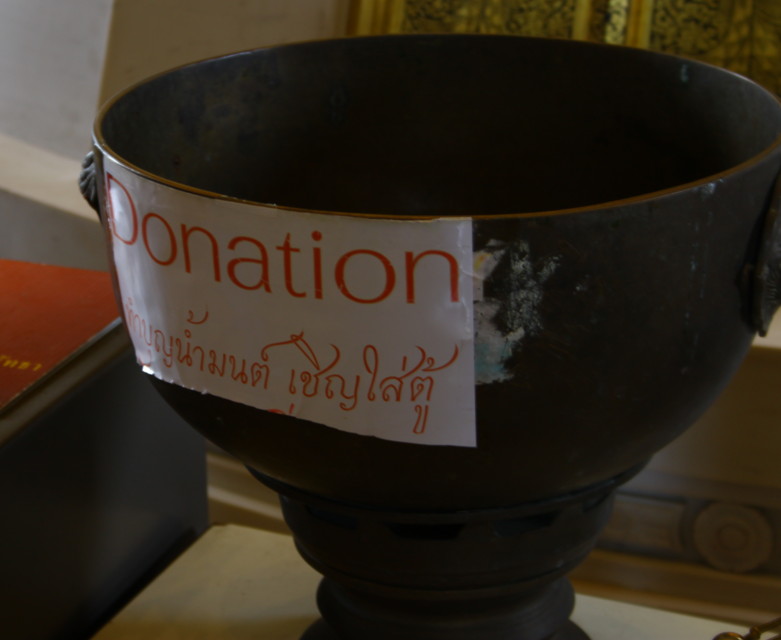
Funny story. You know how clumsy movers notoriously are? Dropping pianos and the like? Well, in 1957, some Thai movers were lifting a 3-metre, 5-ton plaster statue from one temple to another, when something happened to make them drop it from a great height. Hundred-year-old statue gets smashed open... to reveal the sold gold inner statue, the appropriately named Golden Buddha. The temple that owned it must have been thrilled with their clumsy movers. It's thought it was encased in plaster to protect it from the invading Burmese; probably a good idea with 5 tons of solid gold... It;'s a testament to the power of belief that it even got to be 700 year sold - even now, there didn't seem to be much security around, although I'm sure that changes when all the tourists leave. What there was a lot of was donation boxes - about 50 of them, arranged around the room, requesting money for everything from novitiate education to building to upkeep of statues...


...to cattle...


...to everything.


Quite liked the idea of picking your destination though! (No, I didn't pay for cattle...)


Outside the complex I stood by a roadside shrine gazing out at the traffic for a while, undecided and mapless. A man in a blue uniform saw both of these lacks in me and thought he'd rectify the matter for me. Producing a map, he asked me what I'd like to see, and in response to my non-committal mumble, sketched out an itinerary for me. As an afterthought, he added in a gem store, telling me it was a famous one, only open this week to the public and I should just have a look. Then he hailed a tuk-tuk for me (from its sitting position about ten metres away), spoke to the driver about the itinerary, which now included four separate sites, and told me, "40 baht only for the driver." This is just Rm4, or about $1.50-ish. But determined to stuff down the rising tide of suspicion, in I jumped and off we sped.

The first step was for the Lucky Buddha, stored at a shrine in some back streets, 17th century buildings standing in a lovely tree-lined courtyard, completely and utterly empty. A stark contrast with the anthill of Wat Traimit. I took my shoes off and went into the Buddha's room to find that I was wrong about it being completely empty - there was a suited gentleman deep in prayer, his keys and smartphone on the carpet beside him. I hovered at the door in a misguided reluctance to interrupt his prayers, but he turned and saw me and immediately called me in, waving aside my embarrassed protests. I sat beside him for twenty minutes as he told me about the history of the Lucky Buddha and his job in Dubai and Buddhism in Africa and his export business in Dubai and the meaning of the string floating above our heads. Apparently the royal family had been here the previous week and a ceremony had been carried out to bless them and the monastery.


Finally I took pity on the waiting driver and left - just after the praying many looked at my itinerary and raved about the gem factory on it. So. Off we went, my linguistically tongue-tied driver and me, to the gem factory where I was welcomed in by a man in a gleaming suit and guided around some glass cases showing some very expensive sapphires and rubies. When I said I really wasn't going to buy anything, the smiles disappeared and I was shown the door. Literally. They pointed to the door and said, "Okay, you can go out that way." My driver asked me to look at one more place, so that he could get a free fuel coupon. I agreed under duress. I looked at sapphire earrings. I refused to buy. I was left to find my own way out.

The next step was the Golden Mount, at the base of which sprawled Wat Saket. Built on top of the ruins of an earlier shrine, a temple sits at the top of 318 shallow steps, protecting a relic of the Buddha. On the climb up, for your entertainment, there are beautiful bells and gongs and tubs of lotus flowers.


The wat was once the tallest point in Bangkok, which is easy to believe when looking out the door at the spectacular view. The modern city dominates, but like gleaming spears of defiance,a  thousand red-and-gold temples rise through the grey concrete.


Back on the ground I wandered for a short while through the temple complex, where young monks strode about clutching books and bags, through tree-lined avenues. It was so peaceful I found myself thinking it would probably be rather lovely to be a monk here one day... If only there were gender equality, huh?


Back in the main area, as I gazed at a counter selling care packages for Buddhists to buy for the monks, it dawned on me that it was way past the appointed time, and yet my tuk-tuk driver was nowhere to be seen. After a little more wandering and more than a bit of wondering, I approached a taxi driver, who laughed and told me that the driver was long gone, looking for someone who'd actually buy the gems. Of course the fare, which I'd brushed away suspicions about, was inconsequential, and my driver had abandoned it, preferring to spend his time chasing other, more pliable tourists.

I grinned and hailed an empty cab for a trip back to my hotel.

Later I learnt that even the smartly dressed man in the temple was part of an elaborate scam to get me to buy gems at a vastly inflated price in the hopes of reselling them for a profit in my own country. The driver got 200 baht from each shop merely for bringing me there, but the big prize is tourists who spend thousands of dollars, their greed getting the better of them. In the end though, I got a free ride around the city through back roads I wouldn't otherwise have seen, and the driver got a few baht for his pains. I just wish he'd told me instead of leaving me wandering round the carpark like an idiot! It didn't put me off Bangkok, but it did make me long for the simplicity of Laos.

Luckily, I was the proud owner of a train ticket north, for that very night...

Thursday, May 31, 2012

Kuala Lumpur to Hat Yai


The train from K.L. to Hat Yai departed from Platform A at 9:20pm on the dot. Again the beds had already been made up in our carriage, a second-class one this time, but in fact nicer than the first class one. The beds were arranged  parallel to the corridor, each shielded by a curtain. Once I was settled, I was in a private cocoon. A small private cocoon, but at least one with a window! Despite the aircon, sleep came a bit easier tonight, possibly also because of the length of the journey - a whole thirteen hours.


In the morning, I wake up to sunrise over the limestone karsts of Kedah in northern Malaysia.


Thailand arrives in a hurry. We draw up to a station; one end is Malaysia, the other end is Thailand.


We get off the train with all our luggage, cross back to Malaysia, go through emigration, cross into Thailand, go through immigration, then return to Malaysia to await the return of our train, which is being shortened to three carriages for the onward journey, most passengers having disembarked before the border.


Once over the barbed wire border, Southern Thailand is an odd mix of same-same-but-different. The villages have wooden houses with shutters, like Malaysia, but in the gardens are golden shrines. There are lots of 4WD pickups but outside the huddled houses, the landscape isn't of oil palms or rice padis but of thick bush.

At Hat Yai we skillfully dodge the insistent touts ("Hey gorgeous! You wan Haad Yai ride?") and walk to the hotel where I've bought a room for the night. I know we're leaving at 6pm, but I knew I'd be desperate for a shower by this point, and the only hotels that actually offer rooms by the hour are also the hotels that offer ancient massages. 


I think 'ancient' might be a codename, as the bright airy visible massage parlours only offer plain "MASSAGE!!!" I believe the ancient sort are the ones Malaysian men come for - Hat Yai is popular with them for quick cross-border trips. But my friend and I are the only foreign faces we see during our 7-hour stay here.

Sex tourism isn't the only draw, of course. There is also the Wat Hat Yai Nai - which sounds beautiful in a Thai's mouth, and is also very pretty in real life. The reclining Buddha there is the third largest in the world, apparently.


There were other buildings scattered around the complex, and some beautifully kitsch tiny statues to mirror the enormous one.


Hat Yai is the fourth biggest city in Thailand, though you wouldn't know it to look at it. This lack of visible impressiveness is not entirely its fault - with a population of 150,000 people, it can't compete on any level with Bangkok, which boasts of 5.6 million! I'm a little nervous as we board our onward train...


PS I haven't been making a spelling mistake all the way through this post - Hat Yai is the official modern spelling; Haad Yai is the older usage which is still visible on the train station, and it's actually closer to the way Thais pronounce it.